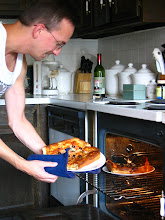
"You're going to want to 'peel' your feet up off the pavement more. And then lay them back down with a mid-sole strike. It'll help you make more of a circular motion with your legs as you run."
This was Laura, helping correct my running form, and quoting directly from Danny Dreyer's excellent book Chi Running. Which, oddly enough, I had her read years ago to improve her running form. Hmm.
I had a negative reaction to this comment, even considering it (wrongly, as we will soon see) vaguely condescending.
My reaction was nothing more than my ego attempting to "protect" me. And what I'd like to do in today's post is explore how dangerous our egos can be when they defensively and aggressively overprotect us.
I'll start by considering reality from my ego's deeply insecure point of view. Assume for the moment that my ego was 100% correct in its worst-case interpretation of Laura's comment: that Laura's intention was to lord over me how terrible my running form was, and by implicit comparison how amazingly perfect her form is. Her comment was intended to condescend and to indicate superiority.
Yes, I know this sounds ridiculous already (I mean, jeez, who wants to go through life automatically assuming negative intent in everything said around you? [1]), but bear with me.
Now, we're both reasonably intelligent people who try to be "meta" about a conversation while we're in it. We're both mostly aware that it pays to say things in such a way that the other people understands the point you're trying to make. Likewise, we also try to be aware that the other person has "intentionality" in what he or she says too. In other words: I can generally assume if something is important enough for Laura to say, there's most likely a decent reason for her to bother to say it.
Otherwise, I've chosen to marry somebody who blithers at me for no discernible reason, something I really don't want to be true.
Once you start considering the real purpose of a conversation about running form (instead of your ego's insecure and false assumptions about that purpose), and once you ruminate a little bit about why somebody might offer a suggestion about something they noticed about your form, you start to see how important intentionality is, and likewise how important it is to assume positive intent in what others say to you.
Let's go back to my ego for a second, and return to my ego's negative interpretation of Laura's statement. My ego arrived at this negative interpretation in a split second, without any real consideration of Laura's intentions. The only thing it "considered" was the idea that I was likely being insulted somehow. Thus my ego reacted in order to protect itself from a potential ego injury... and this ended up preventing me from improving my running form, by insta-rejecting an excellent idea from a book I already knew and totally agreed with.
Thanks ego! Thanks a lot.
It gets even worse. Our ego protection reaction, if habitual, will condition the people around us to never offer any helpful suggestions. Think about it: if I continue to react this way to Laura's ideas and suggestions, eventually she'll stop trying to help me.
A disturbing way to look at this is to conclude that the more reactant your ego, the more your life will be bereft of help in all forms.
Yes, you and I both know the truism about never giving unsolicited advice. But at the same time, helpful suggestions exist for us only if they are said to us, and those helpful ideas and suggestions arrive when they arrive, not necessarily when we want them to arrive. Thus we have to be ready for this help on other peoples' schedules, not on our own. It's just like being consistently ready in case a teacher appears.
There's yet another aspect of our ego protection reflex that's just as pernicious. Consider an example I read recently about trees in a biosphere project. Scientists couldn't understand why all the trees inside of the biosphere kept falling over before they matured. Well, it turns out that if you're a tree inside a biosphere, you never get exposed to wind. Wind is a type of stressor, and trees exposed to wind as they mature become far stronger and resilient.[2]
Essentially, our egos want to keep us in a biosphere, where we never face any wind. Our egos presume negative intent, they presume insult and condescension, and they do so instantly, reflexively. If all we do is react like this, all we'll end up with is a fragile, brittle, easy-to-injure psyche.
So I started peeling up my feet.
Footnotes:
[1] One useful heuristic to use at all times when interacting with others: never, ever assume negative intent in the things other people say.
[2] A fancy word for this is hormesis, or hormetic response. A tree's hormetic response to wind strengthens it over time. For further reading on the human body's hormetic response to running and how even running shoes interfere with hormesis, see also What Barefoot Running Taught Us About Expensive Sneakers (And What Nike and Others Really Don't Want You To Know)
*****************
You can help support the work I do here at Casual Kitchen by visiting Amazon via any link on this site. Amazon pays a small commission to me based on whatever purchase you make on that visit, and it's at no extra cost to you. Thank you!
And, if you are interested at all in cryptocurrencies, yet another way you can help support my work here is to use this link to open up your own cryptocurrency account at Coinbase. I will receive a small affiliate commission with each opened account. Once again, thank you for your support!
Showing posts with label psychology. Show all posts
Showing posts with label psychology. Show all posts


Okay Then, So… When Can I Talk?
All this talk about talking and its role in subverting our actions may have left readers somewhat confused about what they can talk about and when. Heck, I'm confused, and I'm the guy who wrote this stuff in the first place.
Recall that the type of talk we're considering here is the kind that fools our minds' reward centers with "a sense of completion," makes us confuse talk with action, and narcotizes us into apathy and inaction. If we could figure out what kind of talk doesn't do that, that would be awfully helpful.
With that in mind, here are a few general rules for which types of talk you can safely engage in that won't trigger the subversive "sense of completion" loop:
1) You can only talk about actions you have already performed.
a) "Hey, last week I did deadlifts for the first time (and boy are my arms tired!)" (contrast this with "I'm thinking of starting deadlifting" which, as we've seen, produces a sense of completion and therefore prevents you from doing deadlifts)
b) "I did my very first run today, 1.5 miles." (contrast with "I really need to start running.")
c) "I made five new healthy and laughably cheap recipes from Casual Kitchen last month. My grocery bill was down by 45%!" (contrast with "I really should look into ways to cook healthy for less.")
2) You can talk about future tweaks you'd like to make to things you've already done.
"I'm noticing some minor muscle tears all over my rib cage after a few weeks of deadlifting practice. I wonder if adding an occasional cold shower would help my body recover."
3) You can talk about things you don't want to do.
Again, remember: the sense of completion loop means talking about things you want to do makes it more likely you won't do them. Here we simply apply the reverse example, where we use the sense of completion loop on purpose to evade action. Thus, only talk about things if you actually do not want to do them.
A final postscript and disclaimer: Readers, first of all, thanks for being patient with me as I slowly and painstakingly articulate and attempt to solve a challenge I've struggled with, even though it has next to nothing to do with this blog's usual subjects. Second, despite all the prescriptive advice here, please remember that of course you can talk about whatever you want, whenever you want. ;)
*******************
You can help support the work I do here at Casual Kitchen by visiting Amazon via any link on this site. Amazon pays a small commission to me based on whatever purchase you make on that visit, and it's at no extra cost to you. Thank you!
And, if you are interested at all in cryptocurrencies, yet another way you can help support my work here is to use this link to open up your own cryptocurrency account at Coinbase. I will receive a small affiliate commission with each opened account. Once again, thank you for your support!
Recall that the type of talk we're considering here is the kind that fools our minds' reward centers with "a sense of completion," makes us confuse talk with action, and narcotizes us into apathy and inaction. If we could figure out what kind of talk doesn't do that, that would be awfully helpful.
With that in mind, here are a few general rules for which types of talk you can safely engage in that won't trigger the subversive "sense of completion" loop:
1) You can only talk about actions you have already performed.
a) "Hey, last week I did deadlifts for the first time (and boy are my arms tired!)" (contrast this with "I'm thinking of starting deadlifting" which, as we've seen, produces a sense of completion and therefore prevents you from doing deadlifts)
b) "I did my very first run today, 1.5 miles." (contrast with "I really need to start running.")
c) "I made five new healthy and laughably cheap recipes from Casual Kitchen last month. My grocery bill was down by 45%!" (contrast with "I really should look into ways to cook healthy for less.")
2) You can talk about future tweaks you'd like to make to things you've already done.
"I'm noticing some minor muscle tears all over my rib cage after a few weeks of deadlifting practice. I wonder if adding an occasional cold shower would help my body recover."
3) You can talk about things you don't want to do.
Again, remember: the sense of completion loop means talking about things you want to do makes it more likely you won't do them. Here we simply apply the reverse example, where we use the sense of completion loop on purpose to evade action. Thus, only talk about things if you actually do not want to do them.
A final postscript and disclaimer: Readers, first of all, thanks for being patient with me as I slowly and painstakingly articulate and attempt to solve a challenge I've struggled with, even though it has next to nothing to do with this blog's usual subjects. Second, despite all the prescriptive advice here, please remember that of course you can talk about whatever you want, whenever you want. ;)
*******************
You can help support the work I do here at Casual Kitchen by visiting Amazon via any link on this site. Amazon pays a small commission to me based on whatever purchase you make on that visit, and it's at no extra cost to you. Thank you!
And, if you are interested at all in cryptocurrencies, yet another way you can help support my work here is to use this link to open up your own cryptocurrency account at Coinbase. I will receive a small affiliate commission with each opened account. Once again, thank you for your support!
How to Stop Narcotizing Dysfunction
Last week's post was pretty darn depressing wasn't it? Well, at least it depressed me. I can't stand the idea that I might be narcotizing myself, and I certainly don't want to fool myself into thinking I'm being "part of the solution" or "becoming informed" when really I'm just lulling myself (and worse, those around me) into inaction and complacency.
The only course of action is to take action--and so today's post is an attempt to offer solutions that readers (and I) can use to avoid, subvert and beat the problem of narcotizing dysfunction.
Four things:
1) Eliminate the narcotic. What I mean by this, obviously, is stop consuming media. And for good measure, stop all news, all broadcast media, all social media, and most importantly, stop consuming peoples' rage-driven posts about any issue you care about. These things narcotize you and lull you into apathy, while fooling you into thinking you're doing something about the issue. Embrace a low-information, zero-media diet.
2) Read less about the specific issue that's important to you. Not more, less! Admittedly, this seems counter-intuitive. We all like to think we're missing out on being informed when we read less about an issue, but remember, we're up against a media that has interests that differ substantially from our own. In other words, the information made accessible to us through media isn't the information we want. Which brings us to the next solution...
3) While reading less, go directly to the source for your subject or issue information, do not use media or social media intermediaries that distort or impose (their) narratives on the information reaching you. Thus, read books or papers by genuine experts in the subject--and then read an oppositional book by opposing experts to make sure your own brain doesn't impose its own narrative on you either. I'll share an example in the domain of personal investing: I go directly to company quarterly earnings report transcripts (they are free at SeekingAlpha.com) and never read analyst reports or financial media reports telling me their interpretation of what happened. I don't want the intermediary's perception! I want to shape my own.
4) Be aware of the phenomenon itself, always. If you can remind yourself that "this information I'm seeing about issue X (or this discussion I'm having about topic Y) is likely displacing or supplanting action I would rather be taking" you are far less likely to be lulled into narcotized complacency.
5) Take specific action. Fricking actually do something about the thing. And no, once again, posting rubbish on social media does not count. True action involves putting your own skin in the game: If you want to do something about the pay gap, hire a woman. If you want to do something about wealth inequality, teach people how to invest. If you want to do something about XYZ political issue, run for office. If you want to write a novel... write a novel. Do not talk about it or consume media about it unless you wish to be narcotized and made inert and impotent. See how that works?
To summarize:
Eliminate media consumption.
Read less about the issue.
Go directly to source documents; never use informational intermediaries.
Be aware of the phenomenon: you are always at risk of being narcotized.
Take action.
***************************
You can help support the work I do here at Casual Kitchen by visiting Amazon via any link on this site. Amazon pays a small commission to me based on whatever purchase you make on that visit, and it's at no extra cost to you. Thank you!
And, if you are interested at all in cryptocurrencies, yet another way you can help support my work here is to use this link to open up your own cryptocurrency account at Coinbase. I will receive a small affiliate commission with each opened account. Once again, thank you for your support!
The only course of action is to take action--and so today's post is an attempt to offer solutions that readers (and I) can use to avoid, subvert and beat the problem of narcotizing dysfunction.
Four things:
1) Eliminate the narcotic. What I mean by this, obviously, is stop consuming media. And for good measure, stop all news, all broadcast media, all social media, and most importantly, stop consuming peoples' rage-driven posts about any issue you care about. These things narcotize you and lull you into apathy, while fooling you into thinking you're doing something about the issue. Embrace a low-information, zero-media diet.
2) Read less about the specific issue that's important to you. Not more, less! Admittedly, this seems counter-intuitive. We all like to think we're missing out on being informed when we read less about an issue, but remember, we're up against a media that has interests that differ substantially from our own. In other words, the information made accessible to us through media isn't the information we want. Which brings us to the next solution...
3) While reading less, go directly to the source for your subject or issue information, do not use media or social media intermediaries that distort or impose (their) narratives on the information reaching you. Thus, read books or papers by genuine experts in the subject--and then read an oppositional book by opposing experts to make sure your own brain doesn't impose its own narrative on you either. I'll share an example in the domain of personal investing: I go directly to company quarterly earnings report transcripts (they are free at SeekingAlpha.com) and never read analyst reports or financial media reports telling me their interpretation of what happened. I don't want the intermediary's perception! I want to shape my own.
4) Be aware of the phenomenon itself, always. If you can remind yourself that "this information I'm seeing about issue X (or this discussion I'm having about topic Y) is likely displacing or supplanting action I would rather be taking" you are far less likely to be lulled into narcotized complacency.
5) Take specific action. Fricking actually do something about the thing. And no, once again, posting rubbish on social media does not count. True action involves putting your own skin in the game: If you want to do something about the pay gap, hire a woman. If you want to do something about wealth inequality, teach people how to invest. If you want to do something about XYZ political issue, run for office. If you want to write a novel... write a novel. Do not talk about it or consume media about it unless you wish to be narcotized and made inert and impotent. See how that works?
To summarize:
Eliminate media consumption.
Read less about the issue.
Go directly to source documents; never use informational intermediaries.
Be aware of the phenomenon: you are always at risk of being narcotized.
Take action.
***************************
You can help support the work I do here at Casual Kitchen by visiting Amazon via any link on this site. Amazon pays a small commission to me based on whatever purchase you make on that visit, and it's at no extra cost to you. Thank you!
And, if you are interested at all in cryptocurrencies, yet another way you can help support my work here is to use this link to open up your own cryptocurrency account at Coinbase. I will receive a small affiliate commission with each opened account. Once again, thank you for your support!
Narcotizing Dysfunction
Narcotizing dysfunction is a theory that as mass media inundates us on a particular issue, we become increasingly apathetic to that issue.
Worse, we find ourselves substituting factoids and other ersatz knowledge about that issue in place of taking action to help.
As an example, everybody knows about the gender pay gap, and most of us know specific ersatz information about the issue--like the standard factoid women get paid 23% less than men.
But do you know anyone who's actually put their own skin in the game to do anything specific to ameliorate this pay gap? Me neither. And no, posting something about it on social media doesn't count. More on that in a minute.
I used the phrase ersatz knowledge earlier on purpose, because it begs the question whether it's even in our interests at all to know this kind of information. If you really think about it, the "23%" factoid appears to persuade us of something, but at the same time it lulls us into not doing a darn thing about it. It results in people talking rather than doing. Or worse: complaining rather than doing. And just to make sure readers don't get wrapped around the axle about the pay gap as an issue (see the postscript below), we could substitute many other issues in many other domains just as easily, including issues like obesity, saving money and financial independence, the alleged high cost of healthy food, etc.
There's another psychological phenomenon called "sense of completion," by which talking about something--merely talking about it--produces a tiny squirt of dopamine in your brain. That squirt of dopamine, and the small blurt of satisfaction it produces in your mind, is a miniature replica of the genuine sense of satisfaction you'd get if you'd actually completed the task.
Thus we talk about writing a novel, or post something on Twitter/Faceborg about writing a novel, but our talking produces a "miniature replica of satisfaction" that fools us into a feeling of taking action when we haven't. And we end up not writing a novel.
Everyone thinks they don't do this of course. But the truth is, talking is far, far easier than doing, and our brains take the easy route: we talk about doing stuff, we post online about doing stuff, and we don't actually do the stuff. We settle for a mental simulacrum of accomplishment rather than the accomplishment itself.
So now we have two psychological phenomena: sense of completion and narcotizing dysfunction. Both help explain why people are full of natters and they don't do shit. To put it crudely.
Talking, debating, quoting ersatz factoids about "the issues," consuming mass media, and (perhaps worst of all) consuming social media: It all narcotizes us.
If you start to think about these mechanisms, it starts to make you a bit suspicious about what you think, why you think it, and who's giving it to you to think. And, exposure, repeated exposure, to the very factoids you "know" about an issue seem only to keep you inactive. To keep things just as they are.
Call me crazy, but if you wanted to run a gigantic nationwide experiment on how to impose complacency on a society.... this might be how you'd do it.
Once I finally wrapped my mind around these concepts, my desire to debate politics--in fact, my desire to debate most issues, certainly over social media--instantly died.
READ NEXT: How to Use Ersatz Knowledge For YOUR Benefit, Not Theirs
AND: A Terrible Paradox for Locavores
Postscript: A discussion of the gender pay gap is obviously far beyond the scope of this blog and far outside my circle of competence, and as a result I don't have the credibility to offer an opinion on it. Furthermore, keep in mind that this post isn't about the pay gap per se, but about our complacency about any important issue even after we're persuaded.
What's even more intriguing is how there are other types of "gaps" that we never hear about that actually favor women, and in some cases monstrously favor women (examples: workplace deaths, workplace injuries, pay gaps for workers younger than 30). It begs the same questions: why do we all "know" (and are relentlessly fed) the "23% less" factoid, but not the others? And why would we even want to "know" this, then, if the result seems to be nothing more than our complacency? It bakes your noodle just to think about it.
*****************
You can help support the work I do here at Casual Kitchen by visiting Amazon via any link on this site. Amazon pays a small commission to me based on whatever purchase you make on that visit, and it's at no extra cost to you. Thank you!
And, if you are interested at all in cryptocurrencies, yet another way you can help support my work here is to use this link to open up your own cryptocurrency account at Coinbase. I will receive a small affiliate commission with each opened account. Once again, thank you for your support!
Worse, we find ourselves substituting factoids and other ersatz knowledge about that issue in place of taking action to help.
As an example, everybody knows about the gender pay gap, and most of us know specific ersatz information about the issue--like the standard factoid women get paid 23% less than men.
But do you know anyone who's actually put their own skin in the game to do anything specific to ameliorate this pay gap? Me neither. And no, posting something about it on social media doesn't count. More on that in a minute.
I used the phrase ersatz knowledge earlier on purpose, because it begs the question whether it's even in our interests at all to know this kind of information. If you really think about it, the "23%" factoid appears to persuade us of something, but at the same time it lulls us into not doing a darn thing about it. It results in people talking rather than doing. Or worse: complaining rather than doing. And just to make sure readers don't get wrapped around the axle about the pay gap as an issue (see the postscript below), we could substitute many other issues in many other domains just as easily, including issues like obesity, saving money and financial independence, the alleged high cost of healthy food, etc.
There's another psychological phenomenon called "sense of completion," by which talking about something--merely talking about it--produces a tiny squirt of dopamine in your brain. That squirt of dopamine, and the small blurt of satisfaction it produces in your mind, is a miniature replica of the genuine sense of satisfaction you'd get if you'd actually completed the task.
Thus we talk about writing a novel, or post something on Twitter/Faceborg about writing a novel, but our talking produces a "miniature replica of satisfaction" that fools us into a feeling of taking action when we haven't. And we end up not writing a novel.
Everyone thinks they don't do this of course. But the truth is, talking is far, far easier than doing, and our brains take the easy route: we talk about doing stuff, we post online about doing stuff, and we don't actually do the stuff. We settle for a mental simulacrum of accomplishment rather than the accomplishment itself.
So now we have two psychological phenomena: sense of completion and narcotizing dysfunction. Both help explain why people are full of natters and they don't do shit. To put it crudely.
Talking, debating, quoting ersatz factoids about "the issues," consuming mass media, and (perhaps worst of all) consuming social media: It all narcotizes us.
If you start to think about these mechanisms, it starts to make you a bit suspicious about what you think, why you think it, and who's giving it to you to think. And, exposure, repeated exposure, to the very factoids you "know" about an issue seem only to keep you inactive. To keep things just as they are.
Call me crazy, but if you wanted to run a gigantic nationwide experiment on how to impose complacency on a society.... this might be how you'd do it.
Once I finally wrapped my mind around these concepts, my desire to debate politics--in fact, my desire to debate most issues, certainly over social media--instantly died.
READ NEXT: How to Use Ersatz Knowledge For YOUR Benefit, Not Theirs
AND: A Terrible Paradox for Locavores
Postscript: A discussion of the gender pay gap is obviously far beyond the scope of this blog and far outside my circle of competence, and as a result I don't have the credibility to offer an opinion on it. Furthermore, keep in mind that this post isn't about the pay gap per se, but about our complacency about any important issue even after we're persuaded.
What's even more intriguing is how there are other types of "gaps" that we never hear about that actually favor women, and in some cases monstrously favor women (examples: workplace deaths, workplace injuries, pay gaps for workers younger than 30). It begs the same questions: why do we all "know" (and are relentlessly fed) the "23% less" factoid, but not the others? And why would we even want to "know" this, then, if the result seems to be nothing more than our complacency? It bakes your noodle just to think about it.
*****************
You can help support the work I do here at Casual Kitchen by visiting Amazon via any link on this site. Amazon pays a small commission to me based on whatever purchase you make on that visit, and it's at no extra cost to you. Thank you!
And, if you are interested at all in cryptocurrencies, yet another way you can help support my work here is to use this link to open up your own cryptocurrency account at Coinbase. I will receive a small affiliate commission with each opened account. Once again, thank you for your support!
Four Frugality Heuristics [That Will Make You Rich If You Use Them]
Frugality tips are nice, but frugality heuristics are better.
Heuristics--rules of thumb--let you function on a strategy level rather than on a mere tactical level. A few well-thought-out heuristics can take the place of a million specific tips and tactics.
Look, we know retailers and consumer products companies become more and more sophisticated by the day in persuading us, manipulating us and extracting money from us. It is my hope that today's post will help you avoid most, if not all, of the traps and pitfalls awaiting us in the consumer marketplace.
Frugality Heuristic #1: Don't use money to solve problems.
This rule helps you consider alternatives to solving a given need without automatically defaulting to the marketplace to make a purchase. If it's an item you need: could you borrow it, freecycle it, or use something you already own? If it's a service, can you learn to do it yourself, or trade/barter for it? Better still, can you just "don't want!" it? And so on. Bonus: by using this heuristic over the long term, you'll build enormous adaptability, flexibility and resourcefulness.
Frugality Heuristic #2: If they're offering it to you, it's profitable for them--and unprofitable for you.
Notice that things are sold to you if and only if it's worth doing so. It must be meaningfully profitable to the entity doing the selling. Faithfully using this heuristic will protect you from products and services like extended warranties, upsells, excess insurance, most high-fee investment products[1], etc.
Frugality Heuristic #3: If it's advertised, you don't want it.
Remember: You the consumer pay for all advertising. Ad costs are always passed through to the end customer in the form of higher prices, yet despite this, the advertising-consumption model is perhaps one of the best systems ever devised for triggering desires and then separating us from our money. Do not play this game. At the very least, find an equivalent product that isn't advertised. A savvy and intelligent consumer thinks about the enormous cost of heavy advertising, knows that she ends up paying for it, and thus lets advertising become a stimulus not to buy.
Frugality Heuristic #4: Avoid all payment plans.
Payment plans obscure the true price you pay for something, and they almost always substantially increase your final cost[2] while substantially increasing profits to the company offering the payment plan (see Heuristic #2). This heuristic will also save you enormous amounts of money over the course of your life by stopping you from buying things that, if you're honest with yourself, you can't actually afford.
Readers: What other frugality heuristics would you add?
READ NEXT: Good Games
Footnotes:
[1] Note that this goes double for investments, and triple!!!!11! for complex investments like variable annuities, universal life insurance policies, unit investment trusts, etc. Which gives us Investment Heuristic #2a: Do not invest in any investment that is sold to you.
[2] This includes those seemingly attractive 0% financing arrangements from car dealers that calculate your monthly payment by way of a complicated and opaque process. You think you're getting a great deal on a too-good-to-be-true interest rate, while they are likely arranging things such that you pay more than you think. Once again, see Heuristic #2 for the real reason these plans are offered to you in the first place.
***********************
You can help support the work I do here at Casual Kitchen by visiting Amazon via any link on this site. Amazon pays a small commission to me based on whatever purchase you make on that visit, and it's at no extra cost to you. Thank you!
And, if you are interested at all in cryptocurrencies, yet another way you can help support my work here is to use this link to open up your own cryptocurrency account at Coinbase. I will receive a small affiliate commission with each opened account. Once again, thank you for your support!
Heuristics--rules of thumb--let you function on a strategy level rather than on a mere tactical level. A few well-thought-out heuristics can take the place of a million specific tips and tactics.
Look, we know retailers and consumer products companies become more and more sophisticated by the day in persuading us, manipulating us and extracting money from us. It is my hope that today's post will help you avoid most, if not all, of the traps and pitfalls awaiting us in the consumer marketplace.
Frugality Heuristic #1: Don't use money to solve problems.
This rule helps you consider alternatives to solving a given need without automatically defaulting to the marketplace to make a purchase. If it's an item you need: could you borrow it, freecycle it, or use something you already own? If it's a service, can you learn to do it yourself, or trade/barter for it? Better still, can you just "don't want!" it? And so on. Bonus: by using this heuristic over the long term, you'll build enormous adaptability, flexibility and resourcefulness.
Frugality Heuristic #2: If they're offering it to you, it's profitable for them--and unprofitable for you.
Notice that things are sold to you if and only if it's worth doing so. It must be meaningfully profitable to the entity doing the selling. Faithfully using this heuristic will protect you from products and services like extended warranties, upsells, excess insurance, most high-fee investment products[1], etc.
Frugality Heuristic #3: If it's advertised, you don't want it.
Remember: You the consumer pay for all advertising. Ad costs are always passed through to the end customer in the form of higher prices, yet despite this, the advertising-consumption model is perhaps one of the best systems ever devised for triggering desires and then separating us from our money. Do not play this game. At the very least, find an equivalent product that isn't advertised. A savvy and intelligent consumer thinks about the enormous cost of heavy advertising, knows that she ends up paying for it, and thus lets advertising become a stimulus not to buy.
Frugality Heuristic #4: Avoid all payment plans.
Payment plans obscure the true price you pay for something, and they almost always substantially increase your final cost[2] while substantially increasing profits to the company offering the payment plan (see Heuristic #2). This heuristic will also save you enormous amounts of money over the course of your life by stopping you from buying things that, if you're honest with yourself, you can't actually afford.
Readers: What other frugality heuristics would you add?
READ NEXT: Good Games
Footnotes:
[1] Note that this goes double for investments, and triple!!!!11! for complex investments like variable annuities, universal life insurance policies, unit investment trusts, etc. Which gives us Investment Heuristic #2a: Do not invest in any investment that is sold to you.
[2] This includes those seemingly attractive 0% financing arrangements from car dealers that calculate your monthly payment by way of a complicated and opaque process. You think you're getting a great deal on a too-good-to-be-true interest rate, while they are likely arranging things such that you pay more than you think. Once again, see Heuristic #2 for the real reason these plans are offered to you in the first place.
***********************
You can help support the work I do here at Casual Kitchen by visiting Amazon via any link on this site. Amazon pays a small commission to me based on whatever purchase you make on that visit, and it's at no extra cost to you. Thank you!
And, if you are interested at all in cryptocurrencies, yet another way you can help support my work here is to use this link to open up your own cryptocurrency account at Coinbase. I will receive a small affiliate commission with each opened account. Once again, thank you for your support!
Compounding
We think about the word "compounding" in a needlessly narrow sense. Typically, we consider it only in the context of investment compounding. As in: If I save X dollars a month and it compounds at Y percent, I will have [buttloads of] dollars in 30 years.
Today I want to think about compounding more metaphorically and in a broader context. It's a much more powerful concept than it at first appears.
One aspect of compounding that's always interested me is how, over time, it transforms tiny differences today into enormous future differences. If you can stay patient, that is. Sticking with a simple (and once again, "narrow") financial example for the moment, imagine two median income households in the USA, and consider what happens if one household chooses to save and invest a couple hundred bucks a month while the other saves nothing.
At first, there's next to no difference between these households, either economically or in quality of life. To the typical middle class household, $200 doesn't really feel like all that much money. It doesn't feel like it really matters all that much whether you save it or not. Which is of course why many households fail to choose to save.
However, it's also true that saving a couple hundred bucks a month on a median household lifestyle would involve giving up very little. Hilariously little. Cancelling cable TV and getting a lowish-end cellphone plan would do it. Skipping a few dinners out per month would do it. So would choosing to drive a modest paid-off car rather than driving an expensive debt-financed car. Note also: combining all these steps would produce savings well beyond a couple of hundred dollars per month, all for a trivial change in living standards.[1]
So, for the average American household, is saving a couple hundred bucks a month trivial, or not? Certainly in the short run it may seem so. But in the longer run, these two households--with their "trivial" differences in living standards--will begin to diverge economically. Even at modest compounding assumptions of 7% a year (a reasonable guess at future returns for an ultra-low fee broad market index fund), a savings of $200 dollars a month compounds to an astonishing quarter of a million dollars after 30 years. Quite frankly, it's hard to believe such "trivial" incremental savings can morph into sums like this over time, but it's all thanks to compounding.
And that's just the money side of things--this post isn't even supposed to be about money! The truth is, compounding works in far more ways, on far more levels, and with far more nuance. When you start thinking conceptually about compounding, you begin to see many life domains where things start out very small, yet gradually transform into tremendous results over time. Just like that two hundred bucks, except better.
An example. Let's go back to that household above that decided to practice the act of savings, even at a "trivial" level of $200 a month. Actually, it's not trivial in the least, as we'll soon see.
Adopting this practice (think of it as a kata) will "compound" that family's future ability to navigate a wide range of psychological challenges, like deferring gratification, understanding desire triggers, and other psychologically manipulative aspects of modern consumer society.
Further, the meta-skill of how to get better at saving money also compounds: A family that can find a couple of hundred bucks a month in savings today will get far better at saving over time, leading to substantially more future savings.[2] Note further that once you're in a position where you are regularly producing excess savings, you'll gradually compound your competence at intelligently investing that savings. So, a saver will get better at saving, while also improving at investing, while also managing his psychology better, and so on. Level on a level on a level compounding.
What at first glance appears to be a trivial financial baby step later gives rise to a whole range of powerful skills:
* The ability to get better at saving and investing
* The ability to manage yourself psychologically
* The ability to visualize a future and plan for it
* The ability to maintain discipline and install good habits
* The skill of building skills
Better still, all of these skills compound too. You'll get better over time at each as you practice them, and, fascinatingly, your improvement in each augments improvement in all the others. All of a sudden we're talking about a matrix of second- and even third-order compounding.
And to take it one more step further, someone learning how to better navigate her psychology will improve at identifying instances where her ego subverts her efforts to grow. You could easily argue that ego management and ego suppression are the ultimate cross-domain skills.
At this point, an insightful reader should be able to see all sorts of life domains where these wide-ranging skills play formidable, and compounding, roles. Forget about turning a $200 a month into a quarter million bucks--you're thinking way, way too small!
Pushback
There's a predictable--and cynical--response to these ideas, and it deals with the presumed long-term timeframes involved. The pushback (actually it's an excuse) sounds something like this:
Compounding over 20 or 30 years? Years??? I'm already [insert your age here], which means in twenty to thirty years I'll be [choose an age that sounds old]. It's too late!
Let's start with a screaming logic problem. Obviously, the idea of giving up on doing something because you could have started earlier is a particularly toxic form of defeatism. It's also circular. Everybody starts when and where they start. If your first thought is it's too late for me, you're essentially saying that nothing is ever worth doing because you haven't already started. That sure makes sense.
Further, even the central premise of this complaint is flawed: In nearly all the domains we've discussed above, the compounding of skills is so rapid that you don't have to wait 20 or 30 years to get big results.
To see what I mean, think about the central topic of this blog: cooking easy, healthy and laughably cheap meals. This is based on the above skills of a) managing yourself psychologically, and b) visualizing a future and planning for it. Miraculously, you only have to "compound" of a habit of cooking simple and low-cost meals at home for a few weeks to develop substantial competence in effortlessly putting healthy, low-cost meals on your table.
Another example: in his brilliant book How to Be an Imperfectionist, Stephen Guise shows us how a laughably minimal exercise habit of "one pushup" quickly compounds into a well-grooved, consistent fitness habit. Forget years of compounding--that process took more like twenty to thirty days. Psychologically speaking, 20-30 days is about how long it takes us to permanently install a brand new habit.
Even in financial domains, where we typically do think in longer compounding periods, the premise that things take too long is still flawed. The ability to save money, for example, is a skill that compounds very rapidly. The average Your Money Or Your Life reader who quietly and sincerely completes the book's nine steps will develop skills at saving money they never dreamed of in a matter of mere months.
Finally, skills like the ability to manage yourself psychologically and the ability to visualize and plan for the future are intrinsically valuable skills that compound rapidly and can be used in almost any life domain. In other words, they merit practice no matter what your age or life stage happens to be.
Everybody typically thinks about compounding in the limited, long-term financial sense: that of investments requiring multiple decades to grow. Don't let that be you!
Recommended Reading:
1) Anders Ericsson: Peak
2) Stephen Guise: How to Be an Imperfectionist
3) Josh Waitzkin: The Art of Learning
4) Karl Sunstrom: Breaking Out of Homeostasis
Footnotes:
[1] In one of the many intriguing ironies of modern life, "giving up" things like televised media and vehicular status competition actually makes you happier. Anyone who's tried it knows it's true; anyone who doubts it hasn't tried.
[2] Saving $200 a month on a median income represents an extremely low savings rate, less than 5%. [Math: Median income in the USA is currently $59,000, thus $200 a month or $2,400 a year divided by 59,000 = 4.07%.] If you are familiar with just a few concepts from Jacob Lund Fisker's book Early Retirement Extreme, you could easily juice this savings rate enormously.
***********************
You can help support the work I do here at Casual Kitchen by visiting Amazon via any link on this site. Amazon pays a small commission to me based on whatever purchase you make on that visit, and it's at no extra cost to you. Thank you!
And, if you are interested at all in cryptocurrencies, yet another way you can help support my work here is to use this link to open up your own cryptocurrency account at Coinbase. I will receive a small affiliate commission with each opened account. Once again, thank you for your support!
Today I want to think about compounding more metaphorically and in a broader context. It's a much more powerful concept than it at first appears.
One aspect of compounding that's always interested me is how, over time, it transforms tiny differences today into enormous future differences. If you can stay patient, that is. Sticking with a simple (and once again, "narrow") financial example for the moment, imagine two median income households in the USA, and consider what happens if one household chooses to save and invest a couple hundred bucks a month while the other saves nothing.
At first, there's next to no difference between these households, either economically or in quality of life. To the typical middle class household, $200 doesn't really feel like all that much money. It doesn't feel like it really matters all that much whether you save it or not. Which is of course why many households fail to choose to save.
However, it's also true that saving a couple hundred bucks a month on a median household lifestyle would involve giving up very little. Hilariously little. Cancelling cable TV and getting a lowish-end cellphone plan would do it. Skipping a few dinners out per month would do it. So would choosing to drive a modest paid-off car rather than driving an expensive debt-financed car. Note also: combining all these steps would produce savings well beyond a couple of hundred dollars per month, all for a trivial change in living standards.[1]
So, for the average American household, is saving a couple hundred bucks a month trivial, or not? Certainly in the short run it may seem so. But in the longer run, these two households--with their "trivial" differences in living standards--will begin to diverge economically. Even at modest compounding assumptions of 7% a year (a reasonable guess at future returns for an ultra-low fee broad market index fund), a savings of $200 dollars a month compounds to an astonishing quarter of a million dollars after 30 years. Quite frankly, it's hard to believe such "trivial" incremental savings can morph into sums like this over time, but it's all thanks to compounding.
And that's just the money side of things--this post isn't even supposed to be about money! The truth is, compounding works in far more ways, on far more levels, and with far more nuance. When you start thinking conceptually about compounding, you begin to see many life domains where things start out very small, yet gradually transform into tremendous results over time. Just like that two hundred bucks, except better.
An example. Let's go back to that household above that decided to practice the act of savings, even at a "trivial" level of $200 a month. Actually, it's not trivial in the least, as we'll soon see.
Adopting this practice (think of it as a kata) will "compound" that family's future ability to navigate a wide range of psychological challenges, like deferring gratification, understanding desire triggers, and other psychologically manipulative aspects of modern consumer society.
Further, the meta-skill of how to get better at saving money also compounds: A family that can find a couple of hundred bucks a month in savings today will get far better at saving over time, leading to substantially more future savings.[2] Note further that once you're in a position where you are regularly producing excess savings, you'll gradually compound your competence at intelligently investing that savings. So, a saver will get better at saving, while also improving at investing, while also managing his psychology better, and so on. Level on a level on a level compounding.
What at first glance appears to be a trivial financial baby step later gives rise to a whole range of powerful skills:
* The ability to get better at saving and investing
* The ability to manage yourself psychologically
* The ability to visualize a future and plan for it
* The ability to maintain discipline and install good habits
* The skill of building skills
Better still, all of these skills compound too. You'll get better over time at each as you practice them, and, fascinatingly, your improvement in each augments improvement in all the others. All of a sudden we're talking about a matrix of second- and even third-order compounding.
And to take it one more step further, someone learning how to better navigate her psychology will improve at identifying instances where her ego subverts her efforts to grow. You could easily argue that ego management and ego suppression are the ultimate cross-domain skills.
At this point, an insightful reader should be able to see all sorts of life domains where these wide-ranging skills play formidable, and compounding, roles. Forget about turning a $200 a month into a quarter million bucks--you're thinking way, way too small!
Pushback
There's a predictable--and cynical--response to these ideas, and it deals with the presumed long-term timeframes involved. The pushback (actually it's an excuse) sounds something like this:
Compounding over 20 or 30 years? Years??? I'm already [insert your age here], which means in twenty to thirty years I'll be [choose an age that sounds old]. It's too late!
Let's start with a screaming logic problem. Obviously, the idea of giving up on doing something because you could have started earlier is a particularly toxic form of defeatism. It's also circular. Everybody starts when and where they start. If your first thought is it's too late for me, you're essentially saying that nothing is ever worth doing because you haven't already started. That sure makes sense.
Further, even the central premise of this complaint is flawed: In nearly all the domains we've discussed above, the compounding of skills is so rapid that you don't have to wait 20 or 30 years to get big results.
To see what I mean, think about the central topic of this blog: cooking easy, healthy and laughably cheap meals. This is based on the above skills of a) managing yourself psychologically, and b) visualizing a future and planning for it. Miraculously, you only have to "compound" of a habit of cooking simple and low-cost meals at home for a few weeks to develop substantial competence in effortlessly putting healthy, low-cost meals on your table.
Another example: in his brilliant book How to Be an Imperfectionist, Stephen Guise shows us how a laughably minimal exercise habit of "one pushup" quickly compounds into a well-grooved, consistent fitness habit. Forget years of compounding--that process took more like twenty to thirty days. Psychologically speaking, 20-30 days is about how long it takes us to permanently install a brand new habit.
Even in financial domains, where we typically do think in longer compounding periods, the premise that things take too long is still flawed. The ability to save money, for example, is a skill that compounds very rapidly. The average Your Money Or Your Life reader who quietly and sincerely completes the book's nine steps will develop skills at saving money they never dreamed of in a matter of mere months.
Finally, skills like the ability to manage yourself psychologically and the ability to visualize and plan for the future are intrinsically valuable skills that compound rapidly and can be used in almost any life domain. In other words, they merit practice no matter what your age or life stage happens to be.
Everybody typically thinks about compounding in the limited, long-term financial sense: that of investments requiring multiple decades to grow. Don't let that be you!
Recommended Reading:
1) Anders Ericsson: Peak
2) Stephen Guise: How to Be an Imperfectionist
3) Josh Waitzkin: The Art of Learning
4) Karl Sunstrom: Breaking Out of Homeostasis
Footnotes:
[1] In one of the many intriguing ironies of modern life, "giving up" things like televised media and vehicular status competition actually makes you happier. Anyone who's tried it knows it's true; anyone who doubts it hasn't tried.
[2] Saving $200 a month on a median income represents an extremely low savings rate, less than 5%. [Math: Median income in the USA is currently $59,000, thus $200 a month or $2,400 a year divided by 59,000 = 4.07%.] If you are familiar with just a few concepts from Jacob Lund Fisker's book Early Retirement Extreme, you could easily juice this savings rate enormously.
***********************
You can help support the work I do here at Casual Kitchen by visiting Amazon via any link on this site. Amazon pays a small commission to me based on whatever purchase you make on that visit, and it's at no extra cost to you. Thank you!
And, if you are interested at all in cryptocurrencies, yet another way you can help support my work here is to use this link to open up your own cryptocurrency account at Coinbase. I will receive a small affiliate commission with each opened account. Once again, thank you for your support!
The Perfect Question to Ask Before ANY Purchase [For Anticonsumerists Only]
Readers, I've found the perfect question to ask yourself before making any significant purchase. It clarifies everything about your real reasons to buy. Here it is:
If you could tell no one, would you still buy it?
If your answer is yes, then you are probably buying it for the right reasons. However, if your answer is no, you're not buying the item for you. Its purpose is to impress others. And buying things to impress others is a checkers move. [1]
Now, there's a lot going on in the question above, much more than it might appear at first, so let's work through a practical example and unpack what happens psychologically. Let's say you're considering buying a high end watch. If you were to ask yourself would you buy it and tell no one--and no one would ever see it, know about it or hear about it--what would be your likely answer? Be honest.
Your answer would be no, you wouldn't buy it. Simple. If you were being honest with yourself, you'd want to have others see your purchase. Therefore you're buying it for them, not for you! It is a purchase made solely for the purpose of identity construction. Since you don't enjoy playing checkers with your life--you'd much rather play chess--you know you can safely avoid buying this product. It's incredibly helpful and clarifying to know this.
Now, why is this question for anticonsumers only? Because a consumerist will quickly and effortlessly rationalize it away. "Of course I'm buying this $50,000 Patek Philippe watch just for myself. Obviously I would still buy it even if I could never show it to anyone. Plus I'm just not the kind of person would buy something just to show off. I never status signal. That's crass behavior."
I hate to generalize, but I'm going to anyway: In stark contrast with consumerists, anticonsumerists tend to have a deeper understanding (and a deeper humility) about human nature. We are primates. Which means signalling behavior is a structural and foundational part of who we are, and nearly everything we do plays a role in establishing our place in various social hierarchies. Thus to say "I never status signal" is delusional. It's far more accurate to say we are never not status-signalling. [2]
So, after hearing the confidently-stated rationalization above, it's instructive to consider the following two-part question 1) will this person buy the watch, and 2) will he never show it to anyone?
The likely answer: Yes to the first, and a painfully obvious NO to the second. Of course he will show it off. This is why this question doesn't work for consumerists. It's too easy to rationalize away and then, later--after you've forgotten all about the question and your answer--act inconsistently with what you said.
But if you're aware of both your ego and your propensity to rationalize (and more importantly, your propensity to rationalize without thinking you do), the question works. Flawlessly. People with healthy egos know they signal, but they also try their best to avoid buying things to impress others. And they try their best to avoid deceiving themselves about their real reasons for buying things.
Thus thinking about whether you'd never show a new potential purchase to anyone clarifies these reasons. Suddenly, certain purchases seem… off. Ridiculous even. You can safely put your wallet back into your pocket and go on living your life, rather than living to impress everyone else.
READ NEXT: When It Comes To Banning Soda, Marion Nestle Fights Dirty
AND: Oppositional Literature: The Key Tool For Achieving True Intellectual Honesty
Footnotes:
[1] Once someone said to me, "But I like playing checkers!" Not in this metaphor you don't.
[2] Paradoxically, even the act of not status-signalling can be a form of status signal, depending on the nature of your social group. I'll kick your ass in frugality bro!!
I borrowed (okay, stole) the seed idea of this post from Wall Street Playboys, a provocative blog if there ever was one.
***********************
You can help support the work I do here at Casual Kitchen by visiting Amazon via any link on this site. Amazon pays a small commission to me based on whatever purchase you make on that visit, and it's at no extra cost to you. Thank you!
And, if you are interested at all in cryptocurrencies, yet another way you can help support my work here is to use this link to open up your own cryptocurrency account at Coinbase. I will receive a small affiliate commission with each opened account. Once again, thank you for your support!
If you could tell no one, would you still buy it?
If your answer is yes, then you are probably buying it for the right reasons. However, if your answer is no, you're not buying the item for you. Its purpose is to impress others. And buying things to impress others is a checkers move. [1]
Now, there's a lot going on in the question above, much more than it might appear at first, so let's work through a practical example and unpack what happens psychologically. Let's say you're considering buying a high end watch. If you were to ask yourself would you buy it and tell no one--and no one would ever see it, know about it or hear about it--what would be your likely answer? Be honest.
Your answer would be no, you wouldn't buy it. Simple. If you were being honest with yourself, you'd want to have others see your purchase. Therefore you're buying it for them, not for you! It is a purchase made solely for the purpose of identity construction. Since you don't enjoy playing checkers with your life--you'd much rather play chess--you know you can safely avoid buying this product. It's incredibly helpful and clarifying to know this.
Now, why is this question for anticonsumers only? Because a consumerist will quickly and effortlessly rationalize it away. "Of course I'm buying this $50,000 Patek Philippe watch just for myself. Obviously I would still buy it even if I could never show it to anyone. Plus I'm just not the kind of person would buy something just to show off. I never status signal. That's crass behavior."
I hate to generalize, but I'm going to anyway: In stark contrast with consumerists, anticonsumerists tend to have a deeper understanding (and a deeper humility) about human nature. We are primates. Which means signalling behavior is a structural and foundational part of who we are, and nearly everything we do plays a role in establishing our place in various social hierarchies. Thus to say "I never status signal" is delusional. It's far more accurate to say we are never not status-signalling. [2]
So, after hearing the confidently-stated rationalization above, it's instructive to consider the following two-part question 1) will this person buy the watch, and 2) will he never show it to anyone?
The likely answer: Yes to the first, and a painfully obvious NO to the second. Of course he will show it off. This is why this question doesn't work for consumerists. It's too easy to rationalize away and then, later--after you've forgotten all about the question and your answer--act inconsistently with what you said.
But if you're aware of both your ego and your propensity to rationalize (and more importantly, your propensity to rationalize without thinking you do), the question works. Flawlessly. People with healthy egos know they signal, but they also try their best to avoid buying things to impress others. And they try their best to avoid deceiving themselves about their real reasons for buying things.
Thus thinking about whether you'd never show a new potential purchase to anyone clarifies these reasons. Suddenly, certain purchases seem… off. Ridiculous even. You can safely put your wallet back into your pocket and go on living your life, rather than living to impress everyone else.
READ NEXT: When It Comes To Banning Soda, Marion Nestle Fights Dirty
AND: Oppositional Literature: The Key Tool For Achieving True Intellectual Honesty
Footnotes:
[1] Once someone said to me, "But I like playing checkers!" Not in this metaphor you don't.
[2] Paradoxically, even the act of not status-signalling can be a form of status signal, depending on the nature of your social group. I'll kick your ass in frugality bro!!
I borrowed (okay, stole) the seed idea of this post from Wall Street Playboys, a provocative blog if there ever was one.
***********************
You can help support the work I do here at Casual Kitchen by visiting Amazon via any link on this site. Amazon pays a small commission to me based on whatever purchase you make on that visit, and it's at no extra cost to you. Thank you!
And, if you are interested at all in cryptocurrencies, yet another way you can help support my work here is to use this link to open up your own cryptocurrency account at Coinbase. I will receive a small affiliate commission with each opened account. Once again, thank you for your support!
Where Brands (and Pseudo-knowledge) Go to Die
Readers, I wanted to share the following quote--although not for the reasons you might think:
"More students can identify Mr. Peanut and Joe Camel than can identify Abe Lincoln or Eleanor Roosevelt. They can identify twenty different kinds of cold cereal, but not the trees and birds in their neighborhood."
--Mary Pipher, The Shelter of Each Other
This author's point (and on one level she's right) is that people know far more about brands and consumer products than they know about things that actually matter. Worse, we ingest this consumer product knowledge passively. It's deftly inserted into our minds by the media and advertising all around us.
On another level, however, this is one of those fist-shaking "kids these days" quotes every generation hears from its elders and betters. My generation heard this type of crap argument too: One of my favorite "kids these days" media narratives was those articles citing "studies" of how American kids of my generation were terrible in math (or science, or geography, or whatever) compared to Japanese kids. You can see how the media reflects our society's fears back at us: back in the 1970s and 1980s everybody was afraid the Japanese were going to kick our asses in everything and take over the world. Today, kids probably get to hear how academically pathetic they are compared to Indian kids, or Chinese kids. Probably both.
That's why reading quotes like these--reading them on a literal level, that is--often just makes you dumber. (Although note that meta-reading quotes like these may give you useful hints for which country's economy and stock market will collapse in the next decade.)
How long does psuedo-knowledge live?
But the real reason this quote grabbed me was in the way is shows, entirely unintentionally, how incredibly rapidly knowledge (really, pseudo-knowledge) about brands and consumer products becomes totally useless and obsolete.
Mary Pipher's book was first published in 1996, not that long ago. But already her brand references are unrecognizable to young people today. The first thought from someone under age twenty will likely be "What the heck is a Mr. Peanut?" [1] With Joe Camel, it's even worse: since cigarettes haven't been advertised in a generation, nobody young knows or even cares who Joe Camel is today.
And yet Joe Camel seemed like such a big deal in the 1980s and 1990s. Finger-wagging pundits back then were panic-stricken that millions of innocent children would fatally take up smoking because of this friendly cartoon mascot. [2]
There's one more irony, however, and it's the best of all. Today, Mary Pipher's quote is exactly wrong, and for reasons she'd never imagine. Far, far more kids today can identify Abe Lincoln and Eleanor Roosevelt than Mr. Peanut and Joe Camel, because nobody young has ever heard of Mr. Peanut or Joe Camel! So I guess that's pretty good.
With a few notable exceptions, the brands and mascots of prior generations have absolutely zero presence in the minds of the generations behind us. Upcoming generations have enough new pseudo-knowledge of their own: new brands, new products, new shows, media, and advertising mascots all deftly inserted into their brains. And in another few decades we'll collectively forget it all, all over again, and learn still more new crap. The pseudo-knowledge never ends, it just changes.
Thus there's a key difference between knowledge and pseudo-knowledge. One is stable, the other is in a constant state of change, always evolving. Trees, birds and major historical figures don't change; cereal brands and peanut mascots do. You'd think we'd find more value in learning the former versus the latter, but each generation, mine included, always seems to learn the pseudo-knowledge rather than the real thing.
READ NEXT: Is "Meet or Beat" Pricing Anti-Consumer?
AND: Rebellion Practice
Footnotes:
[1] And yet, weirdly, Wikipedia calls Mr. Peanut "one of the best known icons in advertising history." If anything, this just shows how quickly and fully each generation forgets the prior generation's pseudo-knowledge, while it labors to create (and waste time learning) its own.
[2] Totally unrelated sidenote: Many finger-waggers back then were also convinced, Freudian-like, that Joe Camel's face looked just like a penis. Sadly, once someone tells you this and you Google the image, you can never unsee it. Thanks, finger-waggers.
***********************
You can help support the work I do here at Casual Kitchen by visiting Amazon via any link on this site. Amazon pays a small commission to me based on whatever purchase you make on that visit, and it's at no extra cost to you. Thank you!
And, if you are interested at all in cryptocurrencies, yet another way you can help support my work here is to use this link to open up your own cryptocurrency account at Coinbase. I will receive a small affiliate commission with each opened account. Once again, thank you for your support!
"More students can identify Mr. Peanut and Joe Camel than can identify Abe Lincoln or Eleanor Roosevelt. They can identify twenty different kinds of cold cereal, but not the trees and birds in their neighborhood."
--Mary Pipher, The Shelter of Each Other
This author's point (and on one level she's right) is that people know far more about brands and consumer products than they know about things that actually matter. Worse, we ingest this consumer product knowledge passively. It's deftly inserted into our minds by the media and advertising all around us.
On another level, however, this is one of those fist-shaking "kids these days" quotes every generation hears from its elders and betters. My generation heard this type of crap argument too: One of my favorite "kids these days" media narratives was those articles citing "studies" of how American kids of my generation were terrible in math (or science, or geography, or whatever) compared to Japanese kids. You can see how the media reflects our society's fears back at us: back in the 1970s and 1980s everybody was afraid the Japanese were going to kick our asses in everything and take over the world. Today, kids probably get to hear how academically pathetic they are compared to Indian kids, or Chinese kids. Probably both.
That's why reading quotes like these--reading them on a literal level, that is--often just makes you dumber. (Although note that meta-reading quotes like these may give you useful hints for which country's economy and stock market will collapse in the next decade.)
How long does psuedo-knowledge live?
But the real reason this quote grabbed me was in the way is shows, entirely unintentionally, how incredibly rapidly knowledge (really, pseudo-knowledge) about brands and consumer products becomes totally useless and obsolete.
Mary Pipher's book was first published in 1996, not that long ago. But already her brand references are unrecognizable to young people today. The first thought from someone under age twenty will likely be "What the heck is a Mr. Peanut?" [1] With Joe Camel, it's even worse: since cigarettes haven't been advertised in a generation, nobody young knows or even cares who Joe Camel is today.
And yet Joe Camel seemed like such a big deal in the 1980s and 1990s. Finger-wagging pundits back then were panic-stricken that millions of innocent children would fatally take up smoking because of this friendly cartoon mascot. [2]
There's one more irony, however, and it's the best of all. Today, Mary Pipher's quote is exactly wrong, and for reasons she'd never imagine. Far, far more kids today can identify Abe Lincoln and Eleanor Roosevelt than Mr. Peanut and Joe Camel, because nobody young has ever heard of Mr. Peanut or Joe Camel! So I guess that's pretty good.
With a few notable exceptions, the brands and mascots of prior generations have absolutely zero presence in the minds of the generations behind us. Upcoming generations have enough new pseudo-knowledge of their own: new brands, new products, new shows, media, and advertising mascots all deftly inserted into their brains. And in another few decades we'll collectively forget it all, all over again, and learn still more new crap. The pseudo-knowledge never ends, it just changes.
Thus there's a key difference between knowledge and pseudo-knowledge. One is stable, the other is in a constant state of change, always evolving. Trees, birds and major historical figures don't change; cereal brands and peanut mascots do. You'd think we'd find more value in learning the former versus the latter, but each generation, mine included, always seems to learn the pseudo-knowledge rather than the real thing.
READ NEXT: Is "Meet or Beat" Pricing Anti-Consumer?
AND: Rebellion Practice
Footnotes:
[1] And yet, weirdly, Wikipedia calls Mr. Peanut "one of the best known icons in advertising history." If anything, this just shows how quickly and fully each generation forgets the prior generation's pseudo-knowledge, while it labors to create (and waste time learning) its own.
[2] Totally unrelated sidenote: Many finger-waggers back then were also convinced, Freudian-like, that Joe Camel's face looked just like a penis. Sadly, once someone tells you this and you Google the image, you can never unsee it. Thanks, finger-waggers.
***********************
You can help support the work I do here at Casual Kitchen by visiting Amazon via any link on this site. Amazon pays a small commission to me based on whatever purchase you make on that visit, and it's at no extra cost to you. Thank you!
And, if you are interested at all in cryptocurrencies, yet another way you can help support my work here is to use this link to open up your own cryptocurrency account at Coinbase. I will receive a small affiliate commission with each opened account. Once again, thank you for your support!
Good Games
We might start by considering the all-too-black-and-white words themselves: "success" or "failure." You are either a success, a comprehensive, singular, over-all good thing, or its opposite, a failure, a comprehensive, singular irredeemably bad thing. The words imply no alternative and no middle ground. However, in a world as complex as ours, such generalizations (really, such failure to differentiate) are a sign of naive, unsophisticated or even malevolent analysis. There are vital degrees and gradations of value obliterated by this binary system, and the consequences are not good.
To begin with, there is not just one game at which to succeed or fail. There are many games and, more specifically, many good games--games that match your talents, involve you productively with other people, and sustain and even improve themselves across time.
--Jordan Peterson, 12 Rules For Life: An Antidote to Chaos
Jordan Peterson, thanks to his excellent new book 12 Rules For Life, has me thinking, metaphorically, about the various games playable and available to us in life, and how useful it is to think about the world in terms of games. It takes some of the existential pressure off of life, somehow, and it helps you reframe "failure" into "I'm still learning, I'm still working at this, I want to get better."
So what kinds of "games" are there out there that we can play?
Frugality is a game. Getting better at it means you become better able to financially protect your family.
Cooking is a game. The more you "play" it, the better you'll eat and the healthier you'll be.
You can even combine the games of cooking and frugality to make an entirely new game. In fact that was exactly the focus of this blog during its first years.
Blogging is a game. Is this blog a success? Not really. It's not all that widely read, it doesn't make all that much money, it's never had a post that went truly viral, etc. So, no, it's not a success--not by most peoples' definition at least, and certainly not if I were to use the "naive, malevolent analysis" Jordan Peterson warns us not to use in the quote above.
But then again: I've kept at it here for more than ten years, and over that time I've learned an extraordinary amount about writing, to say nothing of learning deeply about all the topics I've covered. There's no better way to learn how little you really know about a subject than to write about it--and this goes double for subjects you think you know well. So, is Casual Kitchen a success?
Investing and personal finance is a game. In fact, thinking of it as a game is an excellent device to help manage the often insurmountable fears many people experience as they begin. It's just a game! Invest a little, learn a little, invest a little more, learn a little more, continue and get better.
Fitness is a game, a game with many, many intriguing subgames. Tennis is a game I've played for years, but a few years ago I began to experience a type of "failure" in tennis: I started bumping up against opponents who were better than I was, and who were improving at faster rates than I was. Some players I used to beat I could no longer beat, some I couldn't beat ever, and my ego didn't like it. At all. And I started to get disaffected (I can't think of a better word) with the game. Certainly, I had all the egoic reason in the world to quit, or to just play easier opponents, etc.
But then, in order to help recover my fitness, my footspeed and my "fight" in tennis, I started up another fitness game: weightlifting. Specifically, I started compound lifting (deadlifts, squats, different types of presses, etc.). This new game had its own rules, standards, failures and successes.
Of course whenever you start a new game, your expectations are low, you are happy to learn, your progress is rapid at first, and your ego doesn't get in the way quite so much. This, again, is why thinking of life in terms of games is so helpful.
Heh. Then again, with weightlifting, my ego did get in the way early on, imagining how idiotic I must have looked doing my first halting deadlifts of a bar with exactly zero pounds on it. But I somehow defied my ego, fought through the imagined-yet-all-too-real embarrassment of being seen as weak, and this opened up an entirely new game that I found deeply satisfying. And, ironically, deeply frustrating all over again as I got better at it and started to see my once-rapid progress start to level off.
Which takes us to yet another game, a type of meta-game: the games we play with our egos. Or perhaps better said: the games our egos play with us.
All of the games I've discussed above have offered me satisfaction and frustration in varying degrees, depending on the behavior--or misbehavior--of my ego. Of maybe it's more accurate to say depending on the degree to which I listen to my ego or do the opposite of what it wants me to do.
Which brings me to my conclusion: The more I do the exact opposite of what my fearful and loathsomely persuasive ego wants me to do, the better all these games tend to go.
Finally, let me recommend 12 Rules For Life: An Antidote to Chaos to readers. It's a generous gift that Jordan Peterson wrote this book, and it's well worth reading.
***********************
You can help support the work I do here at Casual Kitchen by visiting Amazon via any link on this site. Amazon pays a small commission to me based on whatever purchase you make on that visit, and it's at no extra cost to you. Thank you!
And, if you are interested at all in cryptocurrencies, yet another way you can help support my work here is to use this link to open up your own cryptocurrency account at Coinbase. I will receive a small affiliate commission with each opened account. Once again, thank you for your support!
To begin with, there is not just one game at which to succeed or fail. There are many games and, more specifically, many good games--games that match your talents, involve you productively with other people, and sustain and even improve themselves across time.
--Jordan Peterson, 12 Rules For Life: An Antidote to Chaos
Jordan Peterson, thanks to his excellent new book 12 Rules For Life, has me thinking, metaphorically, about the various games playable and available to us in life, and how useful it is to think about the world in terms of games. It takes some of the existential pressure off of life, somehow, and it helps you reframe "failure" into "I'm still learning, I'm still working at this, I want to get better."
So what kinds of "games" are there out there that we can play?
Frugality is a game. Getting better at it means you become better able to financially protect your family.
Cooking is a game. The more you "play" it, the better you'll eat and the healthier you'll be.
You can even combine the games of cooking and frugality to make an entirely new game. In fact that was exactly the focus of this blog during its first years.
Blogging is a game. Is this blog a success? Not really. It's not all that widely read, it doesn't make all that much money, it's never had a post that went truly viral, etc. So, no, it's not a success--not by most peoples' definition at least, and certainly not if I were to use the "naive, malevolent analysis" Jordan Peterson warns us not to use in the quote above.
But then again: I've kept at it here for more than ten years, and over that time I've learned an extraordinary amount about writing, to say nothing of learning deeply about all the topics I've covered. There's no better way to learn how little you really know about a subject than to write about it--and this goes double for subjects you think you know well. So, is Casual Kitchen a success?
Investing and personal finance is a game. In fact, thinking of it as a game is an excellent device to help manage the often insurmountable fears many people experience as they begin. It's just a game! Invest a little, learn a little, invest a little more, learn a little more, continue and get better.
Fitness is a game, a game with many, many intriguing subgames. Tennis is a game I've played for years, but a few years ago I began to experience a type of "failure" in tennis: I started bumping up against opponents who were better than I was, and who were improving at faster rates than I was. Some players I used to beat I could no longer beat, some I couldn't beat ever, and my ego didn't like it. At all. And I started to get disaffected (I can't think of a better word) with the game. Certainly, I had all the egoic reason in the world to quit, or to just play easier opponents, etc.
But then, in order to help recover my fitness, my footspeed and my "fight" in tennis, I started up another fitness game: weightlifting. Specifically, I started compound lifting (deadlifts, squats, different types of presses, etc.). This new game had its own rules, standards, failures and successes.
Of course whenever you start a new game, your expectations are low, you are happy to learn, your progress is rapid at first, and your ego doesn't get in the way quite so much. This, again, is why thinking of life in terms of games is so helpful.
Heh. Then again, with weightlifting, my ego did get in the way early on, imagining how idiotic I must have looked doing my first halting deadlifts of a bar with exactly zero pounds on it. But I somehow defied my ego, fought through the imagined-yet-all-too-real embarrassment of being seen as weak, and this opened up an entirely new game that I found deeply satisfying. And, ironically, deeply frustrating all over again as I got better at it and started to see my once-rapid progress start to level off.
Which takes us to yet another game, a type of meta-game: the games we play with our egos. Or perhaps better said: the games our egos play with us.
All of the games I've discussed above have offered me satisfaction and frustration in varying degrees, depending on the behavior--or misbehavior--of my ego. Of maybe it's more accurate to say depending on the degree to which I listen to my ego or do the opposite of what it wants me to do.
Which brings me to my conclusion: The more I do the exact opposite of what my fearful and loathsomely persuasive ego wants me to do, the better all these games tend to go.
Finally, let me recommend 12 Rules For Life: An Antidote to Chaos to readers. It's a generous gift that Jordan Peterson wrote this book, and it's well worth reading.
***********************
You can help support the work I do here at Casual Kitchen by visiting Amazon via any link on this site. Amazon pays a small commission to me based on whatever purchase you make on that visit, and it's at no extra cost to you. Thank you!
And, if you are interested at all in cryptocurrencies, yet another way you can help support my work here is to use this link to open up your own cryptocurrency account at Coinbase. I will receive a small affiliate commission with each opened account. Once again, thank you for your support!
Don’t Want It! [Also... On the Value of Re-Reading Useful Books]
Readers, I'm re-reading Jacob Lund Fisker's paradigm-shifting book Early Retirement Extreme, and I re-stumbled onto a quote worth sharing.
Giving up wants can be as tough or easy as going on a diet, giving up smoking, or changing other habits dependent on strength of character. However, doing without is often thought of as a sacrifice, especially when strongly attached to material comforts. It's quickly realized (after about a month) that happiness does not stem from being surrounded by possessions, but that being surrounded by them is the result of an addictive habit. Thus, it can be tremendously liberating not to "need" something to be happy.
Since humans need very little, eliminating various wants can go far in terms of solving problems. Can't afford it? Don't want it! Too complicated? Don't want it! Reduce and simplify. Reduce and simplify! An entire aesthetic can and has been formed around this principle, and so the pleasure from following this path can be as strong as the (previous) pleasure of accumulation. However, as there's a point of diminishing returns to the pleasure of accumulation, there's also a point of diminishing returns to the pleasure of giving things up. The optimal point is somewhere in the middle. It should therefore be kept in mind that while eliminating problems can be a very good tool, some will be very tempted to make it their only tool, in which case it becomes a hammer for which the whole world becomes a nail.
--Jacob Lund Fisker, Early Retirement Extreme
What I love about this quote is how it synthesizes and combines ideas from minimalism, frugality, consumerism and consumer empowerment, all of which are frequent discussion topics here at Casual Kitchen.
Also, it brings to mind other worthwhile books I've discussed here at CK, like Marie Kondo's The Life-Changing Magic of Tidying Up and her equally useful follow-up book Spark Joy. Marie Kondo's central idea is to keep only the possessions that truly spark joy in you, with a secondary theme that you can--and probably should--eliminate nearly everything else in your life that doesn't spark joy.
An interesting conclusion that we can draw out from these complementary books and the philosophies behind them is the striking idea that you actually "don't want!" a surprisingly large percentage of your stuff. Maybe you once might have thought you wanted it... but you were wrong. We're often wrong about our wants and needs.
If you can acknowledge this, if you can accept it, not only will you have less stuff (probably a lot less stuff), but you'll also have far more happiness. And more money! Think about it: a meaningful percentage of the things you will buy in the future will be things you ultimately "don't want!" Avoid buying them. It's a great feeling to get rid of stuff, but it's better (not to mention more enriching) to not accumulate stuff at all. Marie Kondo and Jacob Lund Fisker ought to get together for a beer one of these days: their ideas are surprisingly in sync.
And the savings aren't limited just to money. Think of all the time you'll save if you don't have to shop for things you "don't want!", if you don't have to take them home, if you don't have to figure out a place to store them, don't have to dust them, organize them, maintain them, pay for extra square footage in your home to make room for them, and so on. And, obviously, you won't have to agonize over whether or not to discard something you never even bought. The "don't want!" heuristic enables you to avoid the entire exercise. Every time-consuming part of it.
So, lately, I've started using this way of thinking whenever I consider an item or a service that I might need or want: How can I "don't want!" this? How can I avoid acquiring an item, avoid spending money and time, and yet still solve this particular problem I'd like to solve?
*****************
Finally, a closing thought on re-reading books. Only a small fraction of books merit reading once--and a vanishingly small fraction of books merit reading more than once. I'm getting enormous value on my second reading of Jacob's book. It's helping me groove and maintain values and habits I prize deeply, values and habits that I want to make sure I keep in the years to come.
Which books merit re-reading for you? For me, they tend to be books that taught me new or particularly useful habits, or books that helped me shape a new way of thinking about the world. Books like Early Retirement Extreme, Your Money or Your Life and Nicholas Taleb's books The Black Swan and Antifragile all fit this category. William Irvine's excellent book on Stoicism, A Guide to the Good Life, fits. And so on.
What are books that you have (or will) re-read? Why? We can all benefit by hearing about "re-read worthy" books. Share your titles in the comments!
***********************
Readers! You can help support the work I do here at Casual Kitchen by visiting Amazon via any link on this site. Amazon pays a small commission to me based on whatever purchase you make on that visit, and it's at no extra cost to you. Thank you!
And, if you are interested at all in cryptocurrencies, yet another way you can help support my work here is to use this link to open up your own cryptocurrency account at Coinbase. I will receive a small affiliate commission with each opened account. Once again, thank you for your support!
Giving up wants can be as tough or easy as going on a diet, giving up smoking, or changing other habits dependent on strength of character. However, doing without is often thought of as a sacrifice, especially when strongly attached to material comforts. It's quickly realized (after about a month) that happiness does not stem from being surrounded by possessions, but that being surrounded by them is the result of an addictive habit. Thus, it can be tremendously liberating not to "need" something to be happy.
Since humans need very little, eliminating various wants can go far in terms of solving problems. Can't afford it? Don't want it! Too complicated? Don't want it! Reduce and simplify. Reduce and simplify! An entire aesthetic can and has been formed around this principle, and so the pleasure from following this path can be as strong as the (previous) pleasure of accumulation. However, as there's a point of diminishing returns to the pleasure of accumulation, there's also a point of diminishing returns to the pleasure of giving things up. The optimal point is somewhere in the middle. It should therefore be kept in mind that while eliminating problems can be a very good tool, some will be very tempted to make it their only tool, in which case it becomes a hammer for which the whole world becomes a nail.
--Jacob Lund Fisker, Early Retirement Extreme
What I love about this quote is how it synthesizes and combines ideas from minimalism, frugality, consumerism and consumer empowerment, all of which are frequent discussion topics here at Casual Kitchen.
Also, it brings to mind other worthwhile books I've discussed here at CK, like Marie Kondo's The Life-Changing Magic of Tidying Up and her equally useful follow-up book Spark Joy. Marie Kondo's central idea is to keep only the possessions that truly spark joy in you, with a secondary theme that you can--and probably should--eliminate nearly everything else in your life that doesn't spark joy.
An interesting conclusion that we can draw out from these complementary books and the philosophies behind them is the striking idea that you actually "don't want!" a surprisingly large percentage of your stuff. Maybe you once might have thought you wanted it... but you were wrong. We're often wrong about our wants and needs.
If you can acknowledge this, if you can accept it, not only will you have less stuff (probably a lot less stuff), but you'll also have far more happiness. And more money! Think about it: a meaningful percentage of the things you will buy in the future will be things you ultimately "don't want!" Avoid buying them. It's a great feeling to get rid of stuff, but it's better (not to mention more enriching) to not accumulate stuff at all. Marie Kondo and Jacob Lund Fisker ought to get together for a beer one of these days: their ideas are surprisingly in sync.
And the savings aren't limited just to money. Think of all the time you'll save if you don't have to shop for things you "don't want!", if you don't have to take them home, if you don't have to figure out a place to store them, don't have to dust them, organize them, maintain them, pay for extra square footage in your home to make room for them, and so on. And, obviously, you won't have to agonize over whether or not to discard something you never even bought. The "don't want!" heuristic enables you to avoid the entire exercise. Every time-consuming part of it.
So, lately, I've started using this way of thinking whenever I consider an item or a service that I might need or want: How can I "don't want!" this? How can I avoid acquiring an item, avoid spending money and time, and yet still solve this particular problem I'd like to solve?
*****************
Finally, a closing thought on re-reading books. Only a small fraction of books merit reading once--and a vanishingly small fraction of books merit reading more than once. I'm getting enormous value on my second reading of Jacob's book. It's helping me groove and maintain values and habits I prize deeply, values and habits that I want to make sure I keep in the years to come.
Which books merit re-reading for you? For me, they tend to be books that taught me new or particularly useful habits, or books that helped me shape a new way of thinking about the world. Books like Early Retirement Extreme, Your Money or Your Life and Nicholas Taleb's books The Black Swan and Antifragile all fit this category. William Irvine's excellent book on Stoicism, A Guide to the Good Life, fits. And so on.
What are books that you have (or will) re-read? Why? We can all benefit by hearing about "re-read worthy" books. Share your titles in the comments!
***********************
Readers! You can help support the work I do here at Casual Kitchen by visiting Amazon via any link on this site. Amazon pays a small commission to me based on whatever purchase you make on that visit, and it's at no extra cost to you. Thank you!
And, if you are interested at all in cryptocurrencies, yet another way you can help support my work here is to use this link to open up your own cryptocurrency account at Coinbase. I will receive a small affiliate commission with each opened account. Once again, thank you for your support!
How Cut Through The Bullsh*t
It's interesting (uh, well, to me at least) how writing a post on one topic often inspires a tangential post, then another tangential post, and then another... until you're totally orthogonal to the original topic. Two weeks ago I wrote a post on how we fool ourselves by reading and talking about things, then last week I pursued a tangent on how cooking is a beautifully action-based, low-BS domain.
Today is the orthogonal essay: it's a humble (and probably incompetent) effort on my part to structure my thoughts on BS in general, and how to cut through it. It's a bit of a mindwank, it has nothing to do with cooking, and worst of all it's probably too long. Feel free to skip it.
With that friendly warning out of the way, let's get into the BS.
Defining BS
First, let me spend a minute defining what BS is, at least by my thinking. It's when someone starts giving opinions that are:
1) Frequently without any serious knowledge of the subject, and
2) Typically unaccompanied by any concrete action, planning or goals.
Essentially, BS is talk ("tawk") with neither follow-through nor competence.
One other fascinating characteristic of BS: a person BS-ing never thinks he's BS-ing. That's how it works. If you realized you were outside your circle of competence and had no idea what you were talking about, you wouldn't offer an opinion! Or at the least you'd severely qualify that opinion beforehand.
Finally, the worst characteristic of BS: we all do it and we all like to think we don't.
Some examples of BS might be:
* I can't believe how greedy Big Food is. They make all these delicious, high fat foods just to make us all fat.
* Our government was so stupid to bail out the banks back in 2009.
* This summer Tom Brady and Bill Belichick are finally going to split up. I can feel it coming.
* The rich really ought to pay more in taxes.
* The stock market is overvalued and about to crash.
Two quick caveats: First, I'm not saying that these statements are true or false. I could have easily offered contra-statements to each of the above examples and they'd still be BS. Second, there is nothing necessarily wrong with making statements like these. At least from time to time.
But there is, however, something very wrong if this describes the vast majority of the statements someone makes. Why? Because they are all passive (even effete) statements, unaccompanied by personal action, personal growth, or personal accountability.
The single worst source of BS
Of course, the worst source of BS is media-packaged news, and TV news is the worst of the worst. A vast portion of the punditry opining on television, in editorials and in print and online media are spreading BS too, and this gets us into an important (and toxic) aspect of BS: typically, media pundits make highly confident statements with no accountability whatsoever if it turns out that they're wrong. This lack of accountability is important: it's why Nicholas Taleb angrily uses the phrase "BS vendors" to describe most punditry. It's deeply unfair and unethical if you attempt to persuade people around you to hold an opinion, but you yourself have no downside exposure if that opinion is wrong.
Worse still, the media (and its confidently-stated opinions) tends to be the source of most of the topics we talk about. Let's face it, most people need to be given things to think. Sadly, salient, attention-garnering topics like like crime, violence, inflation, unemployment, inequality, obesity, the latest in studies show science, politics, etc., is what the media gives us to think about. And talk about. This is true only to the extent we consume media and news of course.
A simple solution to BS
Now, let's move on to solutions. Let's say someone around you starts regurgitating opinions on some topic du jour. And you, well, you don't enjoy BS-ing. You don't enjoy trading effete opinions about the world or getting into debates over things that are entirely outside your circle of control. You're much more interested in learning something useful about how the other person thinks, or learning something useful about how to navigate reality. How best to cut through the BS?
Here's what to do: use open-ended questions to ask what specific actions others are taking. What specifically are they doing to prepare for the outcomes they consider likely, for the outcomes that will happen if their opinions are correct?
For a concrete example, let's say you're talking to someone opining confidently that the stock market is massively overvalued and about to crash. Useful open-ended questions to ask might be phrased in these ways:
* Tell me, what are you personally doing about this?
* Would you share with me what you are specifically doing in your personal situation to prepare for what you think is going to happen?
* If you think X is a major problem, what actions are your taking, then, to protect yourself and your family?
Suddenly, the conversation stops being about hand-wringing and pontificating and starts being about how to function more effectively in a world where we hold a given set of opinions. It becomes about how to better navigate reality. It becomes useful, actionable and solution-minded, and no longer just "tawk."
Then again, if the person doesn't have a ready answer to any of these questions, if they mumble, if they come up empty-handed and can't immediately offer any concrete actions they've taken... then they are BS-ing. Both themselves and you. It's time to smile, agree and deflect.
In my former investing career, we used a slightly more jargon-based phrasing of the same question: "Okay, so you think X [the stock market's going to crash/hyperinflation is coming/rates are going higher, etc]. How are you positioned?"
The opining person then has an opportunity to describe what specific actions they've taken: in this case it would likely be a list of the various investment actions they've taken to manage any exposure to their opinion set.
This is a gloriously BS-vaporizing question. It tells you instantly if the person is BS-ing your or not. If someone thought hyperinflation was coming and wanted to say so credibly, they'd be able to articulate specific investment actions they've taken to prepare. Instantly.
Thus if the answer is something like "I hold 25% of my assets in gold, the only stocks I have left are either of companies with very strong pricing power or of companies that have direct commodity exposure, I'm experimenting with some small investments in cryptocurrencies, and I recently bought some arable land in Upstate New York just in case" I can be fairly confident that this person is not BS-ing me. Why? Because it's not just "tawk"! He has taken meaningful financial actions to protect himself from the specific risks he's concerned about.
He might be right or he might be wrong, but at least he isn't BS-ing you.
This is totally, totally different from a pundit BS-ing on TV. Media pundits rarely disclose how they are positioned--and they are likely not positioned in any way at all. Thus they get the benefits of media attention today with zero downside and zero accountability if wrong about their opinions.[1] They get all the upside, while you--the consumer innocently seeking advice and counsel from "experts" in the financial media--suffer all the downside.[2]
We're all BS vendors now
If you think about it, the same thing happen in person-to-person BS as happens with media pundit BS-ing: Opining with no downside. Which is why the question "what specific actions have you taken?" is so clarifying and so anti-BS. It takes the conversation into specific solutions so you can see whether the person opining has any skin in the game, and whether their opinion merits being listened to.
One quick caveat: we probably ought to exclude high BS/low personal action domains like sports from this discussion. If someone spouts the opinion "I think Tom Brady and Bill Belichick are finally going to split up this summer." and you ask "what specific actions are you taking to prepare for this?" you'll get a blank stare. At best.
BS heuristics
I'll close this post off with a few more heuristics on high-BS domains:
1) Any domain where there exists jargon easily adopted and regurgitated by everyone (e.g., bump stocks, quantitative easing, tariffs, etc.) is likely a very high-BS domain. The jargon--and our easy use of it--tends to give us a dangerous illusion of knowledge.
2) Some domains are by definition non-action based and therefore high-BS: politics and economics are worst offenders here. See also professional sports. Again, it's totally fine to talk about these or any other BS-heavy topics! Just know it for what it is.
3) Anything heavily covered in the news or media is likely high-BS. Generally these subjects are laughably oversimplified, offer enormous illusion-of-competence risks, and typically the debate is already pre-framed for us, if not outright propagandized. This is a feature, not a bug, of media coverage.
And, to make this post a little more action-based, let me offer two heuristics we can use to detect and limit our own BS:
1) Try to not forget, ever, that we know very much less than we think we know.
2) It pays to drastically limit our strongly-held opinions. At the very least to limit them only to domains that we have actually performed at an advanced level.
These last two heuristics have a lot to do with the deliciously ironic Dunning-Kruger Effect, which essentially says that people vastly overestimate their competence when they are incompetent in a given domain. And once they actually start to get good at that domain, only then do they begin to realize how incompetent they are (and were). This is psychology's embodiment of Bertrand Russell's fabulous quote "The trouble with the world is that the stupid are cocksure and the intelligent are full of doubt."
Which takes us to our final conclusion. In those (likely very, very few) domains where you have truly deep expertise, you will have tremendous humility about your opinions, and if you have a strong opinion it is a reliable indicator that in that domain you are BS-ing and do not know it.
READ NEXT: Using Your Sophistication and Great Taste Against You
Footnotes:
[1] It's a useful exercise for practicing epistemic humility (and also like shooting fish in a barrel) to come up with examples of pundit wrongness. Here are three from the finance and investing media that stick in my mind:
a) "Legendary" investor Bill Miller repeatedly recommended bank stocks on CNBC mere months before the 2008 bank crisis;
b) After allegedly "predicting" the 2008-2009 crash, economic pundit Nouriel "Dr. Doom" Roubini continues, broken record-like, to predict doom and gloom for years afterward, keeping many investors out of one of history's best-performing stock markets.
c) The mother of all stock market "heads I win, tails you lose" BS artists might be Elaine Garzarelli, who after blindly lucking into predicting the 1987 crash became a nearly perfect contrary indicator thanks to the utter wrongness of all her market calls thereafter.
[2] Worse still, articles and interviews about crashes and bubbles get extra coverage, so of course the media brings those to us relentlessly. Think back over the past nine (nine!) years since the 2009 stock market bottom. Have you seen more negative or bearish stories than positive stories in the financial media? How many articles attempted to scare you out of stocks all the way up during this incredible, life-altering bull market? Astute readers might be able to deduce a heuristic here to help them improve their financial decision-making in the future.
[3] If you made it this far down the page, congratulations. :)
***********************
Readers! You can help support the work I do here at Casual Kitchen by visiting Amazon via any link on this site. Amazon pays a small commission to me based on whatever purchase you make on that visit, and it's at no extra cost to you. Thank you!
And, if you are interested at all in cryptocurrencies, yet another way you can help support my work here is to use this link to open up your own cryptocurrency account at Coinbase. I will receive a small affiliate commission with each opened account. Once again, thank you for your support!
Today is the orthogonal essay: it's a humble (and probably incompetent) effort on my part to structure my thoughts on BS in general, and how to cut through it. It's a bit of a mindwank, it has nothing to do with cooking, and worst of all it's probably too long. Feel free to skip it.
With that friendly warning out of the way, let's get into the BS.
Defining BS
First, let me spend a minute defining what BS is, at least by my thinking. It's when someone starts giving opinions that are:
1) Frequently without any serious knowledge of the subject, and
2) Typically unaccompanied by any concrete action, planning or goals.
Essentially, BS is talk ("tawk") with neither follow-through nor competence.
One other fascinating characteristic of BS: a person BS-ing never thinks he's BS-ing. That's how it works. If you realized you were outside your circle of competence and had no idea what you were talking about, you wouldn't offer an opinion! Or at the least you'd severely qualify that opinion beforehand.
Finally, the worst characteristic of BS: we all do it and we all like to think we don't.
Some examples of BS might be:
* I can't believe how greedy Big Food is. They make all these delicious, high fat foods just to make us all fat.
* Our government was so stupid to bail out the banks back in 2009.
* This summer Tom Brady and Bill Belichick are finally going to split up. I can feel it coming.
* The rich really ought to pay more in taxes.
* The stock market is overvalued and about to crash.
Two quick caveats: First, I'm not saying that these statements are true or false. I could have easily offered contra-statements to each of the above examples and they'd still be BS. Second, there is nothing necessarily wrong with making statements like these. At least from time to time.
But there is, however, something very wrong if this describes the vast majority of the statements someone makes. Why? Because they are all passive (even effete) statements, unaccompanied by personal action, personal growth, or personal accountability.
The single worst source of BS
Of course, the worst source of BS is media-packaged news, and TV news is the worst of the worst. A vast portion of the punditry opining on television, in editorials and in print and online media are spreading BS too, and this gets us into an important (and toxic) aspect of BS: typically, media pundits make highly confident statements with no accountability whatsoever if it turns out that they're wrong. This lack of accountability is important: it's why Nicholas Taleb angrily uses the phrase "BS vendors" to describe most punditry. It's deeply unfair and unethical if you attempt to persuade people around you to hold an opinion, but you yourself have no downside exposure if that opinion is wrong.
Worse still, the media (and its confidently-stated opinions) tends to be the source of most of the topics we talk about. Let's face it, most people need to be given things to think. Sadly, salient, attention-garnering topics like like crime, violence, inflation, unemployment, inequality, obesity, the latest in studies show science, politics, etc., is what the media gives us to think about. And talk about. This is true only to the extent we consume media and news of course.
A simple solution to BS
Now, let's move on to solutions. Let's say someone around you starts regurgitating opinions on some topic du jour. And you, well, you don't enjoy BS-ing. You don't enjoy trading effete opinions about the world or getting into debates over things that are entirely outside your circle of control. You're much more interested in learning something useful about how the other person thinks, or learning something useful about how to navigate reality. How best to cut through the BS?
Here's what to do: use open-ended questions to ask what specific actions others are taking. What specifically are they doing to prepare for the outcomes they consider likely, for the outcomes that will happen if their opinions are correct?
For a concrete example, let's say you're talking to someone opining confidently that the stock market is massively overvalued and about to crash. Useful open-ended questions to ask might be phrased in these ways:
* Tell me, what are you personally doing about this?
* Would you share with me what you are specifically doing in your personal situation to prepare for what you think is going to happen?
* If you think X is a major problem, what actions are your taking, then, to protect yourself and your family?
Suddenly, the conversation stops being about hand-wringing and pontificating and starts being about how to function more effectively in a world where we hold a given set of opinions. It becomes about how to better navigate reality. It becomes useful, actionable and solution-minded, and no longer just "tawk."
Then again, if the person doesn't have a ready answer to any of these questions, if they mumble, if they come up empty-handed and can't immediately offer any concrete actions they've taken... then they are BS-ing. Both themselves and you. It's time to smile, agree and deflect.
In my former investing career, we used a slightly more jargon-based phrasing of the same question: "Okay, so you think X [the stock market's going to crash/hyperinflation is coming/rates are going higher, etc]. How are you positioned?"
The opining person then has an opportunity to describe what specific actions they've taken: in this case it would likely be a list of the various investment actions they've taken to manage any exposure to their opinion set.
This is a gloriously BS-vaporizing question. It tells you instantly if the person is BS-ing your or not. If someone thought hyperinflation was coming and wanted to say so credibly, they'd be able to articulate specific investment actions they've taken to prepare. Instantly.
Thus if the answer is something like "I hold 25% of my assets in gold, the only stocks I have left are either of companies with very strong pricing power or of companies that have direct commodity exposure, I'm experimenting with some small investments in cryptocurrencies, and I recently bought some arable land in Upstate New York just in case" I can be fairly confident that this person is not BS-ing me. Why? Because it's not just "tawk"! He has taken meaningful financial actions to protect himself from the specific risks he's concerned about.
He might be right or he might be wrong, but at least he isn't BS-ing you.
This is totally, totally different from a pundit BS-ing on TV. Media pundits rarely disclose how they are positioned--and they are likely not positioned in any way at all. Thus they get the benefits of media attention today with zero downside and zero accountability if wrong about their opinions.[1] They get all the upside, while you--the consumer innocently seeking advice and counsel from "experts" in the financial media--suffer all the downside.[2]
We're all BS vendors now
If you think about it, the same thing happen in person-to-person BS as happens with media pundit BS-ing: Opining with no downside. Which is why the question "what specific actions have you taken?" is so clarifying and so anti-BS. It takes the conversation into specific solutions so you can see whether the person opining has any skin in the game, and whether their opinion merits being listened to.
One quick caveat: we probably ought to exclude high BS/low personal action domains like sports from this discussion. If someone spouts the opinion "I think Tom Brady and Bill Belichick are finally going to split up this summer." and you ask "what specific actions are you taking to prepare for this?" you'll get a blank stare. At best.
BS heuristics
I'll close this post off with a few more heuristics on high-BS domains:
1) Any domain where there exists jargon easily adopted and regurgitated by everyone (e.g., bump stocks, quantitative easing, tariffs, etc.) is likely a very high-BS domain. The jargon--and our easy use of it--tends to give us a dangerous illusion of knowledge.
2) Some domains are by definition non-action based and therefore high-BS: politics and economics are worst offenders here. See also professional sports. Again, it's totally fine to talk about these or any other BS-heavy topics! Just know it for what it is.
3) Anything heavily covered in the news or media is likely high-BS. Generally these subjects are laughably oversimplified, offer enormous illusion-of-competence risks, and typically the debate is already pre-framed for us, if not outright propagandized. This is a feature, not a bug, of media coverage.
And, to make this post a little more action-based, let me offer two heuristics we can use to detect and limit our own BS:
1) Try to not forget, ever, that we know very much less than we think we know.
2) It pays to drastically limit our strongly-held opinions. At the very least to limit them only to domains that we have actually performed at an advanced level.
These last two heuristics have a lot to do with the deliciously ironic Dunning-Kruger Effect, which essentially says that people vastly overestimate their competence when they are incompetent in a given domain. And once they actually start to get good at that domain, only then do they begin to realize how incompetent they are (and were). This is psychology's embodiment of Bertrand Russell's fabulous quote "The trouble with the world is that the stupid are cocksure and the intelligent are full of doubt."
Which takes us to our final conclusion. In those (likely very, very few) domains where you have truly deep expertise, you will have tremendous humility about your opinions, and if you have a strong opinion it is a reliable indicator that in that domain you are BS-ing and do not know it.
READ NEXT: Using Your Sophistication and Great Taste Against You
Footnotes:
[1] It's a useful exercise for practicing epistemic humility (and also like shooting fish in a barrel) to come up with examples of pundit wrongness. Here are three from the finance and investing media that stick in my mind:
a) "Legendary" investor Bill Miller repeatedly recommended bank stocks on CNBC mere months before the 2008 bank crisis;
b) After allegedly "predicting" the 2008-2009 crash, economic pundit Nouriel "Dr. Doom" Roubini continues, broken record-like, to predict doom and gloom for years afterward, keeping many investors out of one of history's best-performing stock markets.
c) The mother of all stock market "heads I win, tails you lose" BS artists might be Elaine Garzarelli, who after blindly lucking into predicting the 1987 crash became a nearly perfect contrary indicator thanks to the utter wrongness of all her market calls thereafter.
[2] Worse still, articles and interviews about crashes and bubbles get extra coverage, so of course the media brings those to us relentlessly. Think back over the past nine (nine!) years since the 2009 stock market bottom. Have you seen more negative or bearish stories than positive stories in the financial media? How many articles attempted to scare you out of stocks all the way up during this incredible, life-altering bull market? Astute readers might be able to deduce a heuristic here to help them improve their financial decision-making in the future.
[3] If you made it this far down the page, congratulations. :)
***********************
Readers! You can help support the work I do here at Casual Kitchen by visiting Amazon via any link on this site. Amazon pays a small commission to me based on whatever purchase you make on that visit, and it's at no extra cost to you. Thank you!
And, if you are interested at all in cryptocurrencies, yet another way you can help support my work here is to use this link to open up your own cryptocurrency account at Coinbase. I will receive a small affiliate commission with each opened account. Once again, thank you for your support!
There’s No BS in Cooking
A few follow-up thoughts on last week's post on the difference between doing things and talking about doing things.
Cooking gives us a striking illustration of this difference. You can talk about cooking, you can read about it, you can watch shows about it. But it's painfully obvious to everyone that none of these things is cooking. You can't demonstrate you "know" cooking without actually performing the action of cooking.
Better still, in cooking there is a far lower risk of fooling ourselves with a "psychological sense of completion" compared to other domains. And it's interesting to think about why: it boils down to ego injury. If we make a practice of ingredient bragging, or worse, blather in conversation about advanced cooking techniques yet we can't actually cook, it would be a tremendous ego injury if we get found out. It would be transparently pathetic. Therefore, because the risk of embarrassment is too great, our egos don't (and won't) risk pretending to have expertise we don't have.
All of this makes cooking a wonderfully BS-free domain.
In stark contrast, other fields are buried in BS. Have you ever heard an out-of-shape person talking pseudo-knowledgeably about fitness regimens or diets? Another example: in my former professional field of investing, it's hilariously common to hear people blather on about the stock market or the economy with zero knowledge whatsoever behind their talk. (We're clearly in a stock market bubble right now, and I'm deeply concerned about hyperinflation and ultra-high interest rates once the Treasury stops QE.)
Of course the worst of all examples is the domain of politics. We're all experts here. We all feel justified in having strongly held political opinions, even though 99.9% of us have never held any actual political responsibility and half of the electorate doesn't even vote.
Cooking is refreshingly different, and I wonder if one of the reasons I like it so much as a subject (and why I find so many metaphors and so much to talk about in it) is because it's an action-based, non-bullshit domain. If you can cook something you can cook it. You don't talk to demonstrate your competence in cooking, you don't regurgitate factoids and jargon in conversation to demonstrate your competence in cooking, you cook to demonstrate your competence in cooking. There's no way to hide behind "tawk" like there is in all these other domains.
Have you ever heard anyone sling cooking jargon without knowing anything in the same way people constantly sling investing (or economic, or political) jargon without knowing anything? (Yesterday I was chiffonading some local organic collard greens, and I thought, gosh, if I brunoise-diced them instead, they would go great in a sugo that I could simmer in my Chinese ding.)
That is a sentence I'm fairly confident I will never hear spoken. And certainly not by someone who has no idea how to cook.
Sure, okay, there's ingredient bragging and virtue-signaling in cooking. Nothing's ever perfect. And yes, sure, people do watch cooking shows and don't actually cook. But nobody's ego confuses this with actual cooking. You show you can cook by cooking, by preparing food and serving it to friends and family and having them enjoy it. It's refreshing.
READ NEXT: You May Now Ignore All Scientific Studies
***********************
Readers! You can help support the work I do here at Casual Kitchen by visiting Amazon via any link on this site. Amazon pays a small commission to me based on whatever purchase you make on that visit, and it's at no extra cost to you. Thank you!
And, if you are interested at all in cryptocurrencies, yet another way you can help support my work here is to use this link to open up your own cryptocurrency account at Coinbase. I will receive a small affiliate commission with each opened account. Once again, thank you for your support!
Cooking gives us a striking illustration of this difference. You can talk about cooking, you can read about it, you can watch shows about it. But it's painfully obvious to everyone that none of these things is cooking. You can't demonstrate you "know" cooking without actually performing the action of cooking.
Better still, in cooking there is a far lower risk of fooling ourselves with a "psychological sense of completion" compared to other domains. And it's interesting to think about why: it boils down to ego injury. If we make a practice of ingredient bragging, or worse, blather in conversation about advanced cooking techniques yet we can't actually cook, it would be a tremendous ego injury if we get found out. It would be transparently pathetic. Therefore, because the risk of embarrassment is too great, our egos don't (and won't) risk pretending to have expertise we don't have.
All of this makes cooking a wonderfully BS-free domain.
In stark contrast, other fields are buried in BS. Have you ever heard an out-of-shape person talking pseudo-knowledgeably about fitness regimens or diets? Another example: in my former professional field of investing, it's hilariously common to hear people blather on about the stock market or the economy with zero knowledge whatsoever behind their talk. (We're clearly in a stock market bubble right now, and I'm deeply concerned about hyperinflation and ultra-high interest rates once the Treasury stops QE.)
Of course the worst of all examples is the domain of politics. We're all experts here. We all feel justified in having strongly held political opinions, even though 99.9% of us have never held any actual political responsibility and half of the electorate doesn't even vote.
Cooking is refreshingly different, and I wonder if one of the reasons I like it so much as a subject (and why I find so many metaphors and so much to talk about in it) is because it's an action-based, non-bullshit domain. If you can cook something you can cook it. You don't talk to demonstrate your competence in cooking, you don't regurgitate factoids and jargon in conversation to demonstrate your competence in cooking, you cook to demonstrate your competence in cooking. There's no way to hide behind "tawk" like there is in all these other domains.
Have you ever heard anyone sling cooking jargon without knowing anything in the same way people constantly sling investing (or economic, or political) jargon without knowing anything? (Yesterday I was chiffonading some local organic collard greens, and I thought, gosh, if I brunoise-diced them instead, they would go great in a sugo that I could simmer in my Chinese ding.)
That is a sentence I'm fairly confident I will never hear spoken. And certainly not by someone who has no idea how to cook.
Sure, okay, there's ingredient bragging and virtue-signaling in cooking. Nothing's ever perfect. And yes, sure, people do watch cooking shows and don't actually cook. But nobody's ego confuses this with actual cooking. You show you can cook by cooking, by preparing food and serving it to friends and family and having them enjoy it. It's refreshing.
READ NEXT: You May Now Ignore All Scientific Studies
***********************
Readers! You can help support the work I do here at Casual Kitchen by visiting Amazon via any link on this site. Amazon pays a small commission to me based on whatever purchase you make on that visit, and it's at no extra cost to you. Thank you!
And, if you are interested at all in cryptocurrencies, yet another way you can help support my work here is to use this link to open up your own cryptocurrency account at Coinbase. I will receive a small affiliate commission with each opened account. Once again, thank you for your support!
Fooling Ourselves With Tips and Listicles
A list of tips on "how to do X" is a standard modern mass media staple. If one of these articles happens to come to you (usually via social media), it will likely have three predictable characteristics: it was SEO-optimized, it's a listicle-style article with a clickbait-y title, and it should take roughly three to four minutes to read.
It might even contain useful advice.
People process articles like these in cognitively intriguing ways. For example, one can read a list of 12 Obscenely Easy Tips to Save Money! with a skim-til-offended mindset. And as soon as you stumble onto a tip that strikes you as dumb (cut my own hair? ZOMG only a total loser would do that), you can mentally dismiss the article. Even the entire domain.
What's happening here, cognitively speaking, is the reader reacted by doubling down on her existing belief set. She was waiting, just waiting, for any tip that seemed even the slightest bit stupid. And since some money-saving tips actually are dumb, it should be unsurprising that she found one. The exercise of reading the article--with her specific mindset--reinforces all her worst suspicions about frugality.
What's also astounding is how this reader can actually say she read something "from the other side" and yet, somehow, she still finds evidence confirming her existing beliefs! (See how dumb frugality tips are? Sheesh.) This reader achieved a rare cognitive twofer: she both increased her epistemic arrogance and got slightly dumber at the same time. [Note: this never happens with politics.]
Now, let's consider another example. What if you like frugality (or whatever subject the listicle of "X Easy Tips" happens to cover) and you actually want to put the ideas to work?
Believe it or not, for you, there's an even more dangerous way to read articles like this, especially if it also involves talking about the topic with peers or friends. As much as we wish it weren't true, our brains confuse reading and talking about a domain with practicing that domain.
This deeply unfortunate phenomenon happens in all areas of personal development: losing weight, fitness, cooking at home, writing a novel, decluttering, investing, starting a business, the list goes on. We finish the article--"6 Staggering Advantages of ETFs" let's say--and then we demonstrate our rapidly growing knowledge by regurgitating it in a conversation with a friend. (I've been reading up a lot lately on investing, I'm really leaning towards ETFs rather than index funds. What about you?)
What happens next is fascinating. Our brains get a quick mini-squirt of dopamine and we achieve what psychologists call "a sense of completion." Which means we vaguely feel like we've done something to change our life situation even though we've actually done nothing and taken no action whatsoever.
Pretty soon we'll forget all about the whole thing, and we'll move on to some other listicle-friendly domain. ("8 Awesome Ways to Lose Weight That Big Food Doesn't Want You To Know About!")
It all makes me wonder sometimes whether there's an entirely inverse relationship between how much people read and talk about doing things and to what extent they actually do them.
READ NEXT: Tips Vs. Strategies
And: Epistemic Arrogance
***********************
Readers! You can help support the work I do here at Casual Kitchen by visiting Amazon via any link on this site. Amazon pays a small commission to me based on whatever purchase you make on that visit, and it's at no extra cost to you. Thank you!
And, if you are interested at all in cryptocurrencies, yet another way you can help support my work here is to use this link to open up your own cryptocurrency account at Coinbase. I will receive a small affiliate commission with each opened account. Once again, thank you for your support!
It might even contain useful advice.
People process articles like these in cognitively intriguing ways. For example, one can read a list of 12 Obscenely Easy Tips to Save Money! with a skim-til-offended mindset. And as soon as you stumble onto a tip that strikes you as dumb (cut my own hair? ZOMG only a total loser would do that), you can mentally dismiss the article. Even the entire domain.
What's happening here, cognitively speaking, is the reader reacted by doubling down on her existing belief set. She was waiting, just waiting, for any tip that seemed even the slightest bit stupid. And since some money-saving tips actually are dumb, it should be unsurprising that she found one. The exercise of reading the article--with her specific mindset--reinforces all her worst suspicions about frugality.
What's also astounding is how this reader can actually say she read something "from the other side" and yet, somehow, she still finds evidence confirming her existing beliefs! (See how dumb frugality tips are? Sheesh.) This reader achieved a rare cognitive twofer: she both increased her epistemic arrogance and got slightly dumber at the same time. [Note: this never happens with politics.]
Now, let's consider another example. What if you like frugality (or whatever subject the listicle of "X Easy Tips" happens to cover) and you actually want to put the ideas to work?
Believe it or not, for you, there's an even more dangerous way to read articles like this, especially if it also involves talking about the topic with peers or friends. As much as we wish it weren't true, our brains confuse reading and talking about a domain with practicing that domain.
This deeply unfortunate phenomenon happens in all areas of personal development: losing weight, fitness, cooking at home, writing a novel, decluttering, investing, starting a business, the list goes on. We finish the article--"6 Staggering Advantages of ETFs" let's say--and then we demonstrate our rapidly growing knowledge by regurgitating it in a conversation with a friend. (I've been reading up a lot lately on investing, I'm really leaning towards ETFs rather than index funds. What about you?)
What happens next is fascinating. Our brains get a quick mini-squirt of dopamine and we achieve what psychologists call "a sense of completion." Which means we vaguely feel like we've done something to change our life situation even though we've actually done nothing and taken no action whatsoever.
Pretty soon we'll forget all about the whole thing, and we'll move on to some other listicle-friendly domain. ("8 Awesome Ways to Lose Weight That Big Food Doesn't Want You To Know About!")
It all makes me wonder sometimes whether there's an entirely inverse relationship between how much people read and talk about doing things and to what extent they actually do them.
READ NEXT: Tips Vs. Strategies
And: Epistemic Arrogance
***********************
Readers! You can help support the work I do here at Casual Kitchen by visiting Amazon via any link on this site. Amazon pays a small commission to me based on whatever purchase you make on that visit, and it's at no extra cost to you. Thank you!
And, if you are interested at all in cryptocurrencies, yet another way you can help support my work here is to use this link to open up your own cryptocurrency account at Coinbase. I will receive a small affiliate commission with each opened account. Once again, thank you for your support!
Ingredient Bragging
A long-time CK reader, Stuart at Addicted to Canning, ran a post recently about recipes with pretentious, impossible to find, or inappropriately up-market ingredients.
For example, let's say you offer your readers a recipe that includes potatoes. But instead of just writing "potatoes" in your list of ingredients, you (unnecessarily) write "organic, local potatoes."
Here are some other examples:
* Instead of writing "milk" as a recipe ingredient, write "raw milk"
* Instead of "chocolate" (say for my Mole recipe) write "fair trade, organic chocolate"
* Instead of "carrots" write "local, organic Purple Dragon carrots"
* Instead of "pork shoulder" write "pork shoulder from traditional hog breeds finished on acorns"
I bet you think I'm joking about that last one. Sadly, I'm not.
This is a surprisingly common phenomenon in food blogging, and we need a new phrase for it. So allow me to coin one: ingredient bragging.
When offering a recipe to strangers over the internet, self-aware food bloggers know full well that they can simply write ingredients as is. If a recipe requires carrots, the word "carrots" suffices. If an individual reader wishes to use organic carrots, local carrots, carrots from their backyard garden, cruelty-free Purple Dragon carrots from their local hipster farm market--or, uh, just carrots--they can.
Now, I fear that any food blogger who actually needs to be told this is already beyond help, but... if you actually write local, organic Purple Dragon carrots as a recipe ingredient, you impose an obligation on your readers: an obligation to restrain themselves from throwing their laptops across the room. You've pretentiously given your readers a non-obtainable, expensive and frou-frou ingredient, and then forced them to ask various near-existential questions:
Does this recipe really require Purple Dragon carrots?
What the heck IS a Purple Dragon carrot, and where could I possibly buy one?
Can I substitute just... carrots? Am I a bad person if they're not organic?
How much longer is this urge to throw my laptop across the room going to last?
Your readers only just read your recipe, and already they hate you.
But there's more to ingredient bragging than just pretension. And annoying your readers. And doubling their time spent shopping. And quadrupling their grocery bills. And replacing their laptops. There's more going on here.
If we really want people to cook at home--for health reasons, for economic reasons, for personal development reasons, for whatever reason--we want to make cooking accessible. Ingredient bragging does not make cooking accessible. On the contrary, it makes cooking seem far more difficult and far more expensive than it really is. It actually encourages people not to cook! This was Stuart's point in his post, and it's a good one.
But worst of all--worst, worst, worst of all--is the bald-faced status signalling. If you have the temerity to engage in ingredient bragging you are openly, transparently and unnecessarily signalling your status. You are overtly advertising that you are the type of person who of course always buys these high end ingredients. You are elevated and refined, and you want to make sure everybody knows it. In fact, it's so important that your high status be known that you will remorselessly make your readers' lives more expensive and more difficult in order to signal so.
Ingredient bragging: Just don't do it.
Readers, what are your thoughts?
PS: Every new annoying trend ought to have its own neologism. When I touched on this topic before here at CK, I called it organic-dropping, an admittedly stone-handed portmanteau of organic and name-dropping. Readers, I hope you like ingredient bragging better.
***********************
Readers! You can help support the work I do here at Casual Kitchen by visiting Amazon via any link on this site. Amazon pays a small commission to me based on whatever purchase you make on that visit, and it's at no extra cost to you. Thank you!
For example, let's say you offer your readers a recipe that includes potatoes. But instead of just writing "potatoes" in your list of ingredients, you (unnecessarily) write "organic, local potatoes."
Here are some other examples:
* Instead of writing "milk" as a recipe ingredient, write "raw milk"
* Instead of "chocolate" (say for my Mole recipe) write "fair trade, organic chocolate"
* Instead of "carrots" write "local, organic Purple Dragon carrots"
* Instead of "pork shoulder" write "pork shoulder from traditional hog breeds finished on acorns"
I bet you think I'm joking about that last one. Sadly, I'm not.
This is a surprisingly common phenomenon in food blogging, and we need a new phrase for it. So allow me to coin one: ingredient bragging.
When offering a recipe to strangers over the internet, self-aware food bloggers know full well that they can simply write ingredients as is. If a recipe requires carrots, the word "carrots" suffices. If an individual reader wishes to use organic carrots, local carrots, carrots from their backyard garden, cruelty-free Purple Dragon carrots from their local hipster farm market--or, uh, just carrots--they can.
Now, I fear that any food blogger who actually needs to be told this is already beyond help, but... if you actually write local, organic Purple Dragon carrots as a recipe ingredient, you impose an obligation on your readers: an obligation to restrain themselves from throwing their laptops across the room. You've pretentiously given your readers a non-obtainable, expensive and frou-frou ingredient, and then forced them to ask various near-existential questions:
Does this recipe really require Purple Dragon carrots?
What the heck IS a Purple Dragon carrot, and where could I possibly buy one?
Can I substitute just... carrots? Am I a bad person if they're not organic?
How much longer is this urge to throw my laptop across the room going to last?
Your readers only just read your recipe, and already they hate you.
But there's more to ingredient bragging than just pretension. And annoying your readers. And doubling their time spent shopping. And quadrupling their grocery bills. And replacing their laptops. There's more going on here.
If we really want people to cook at home--for health reasons, for economic reasons, for personal development reasons, for whatever reason--we want to make cooking accessible. Ingredient bragging does not make cooking accessible. On the contrary, it makes cooking seem far more difficult and far more expensive than it really is. It actually encourages people not to cook! This was Stuart's point in his post, and it's a good one.
But worst of all--worst, worst, worst of all--is the bald-faced status signalling. If you have the temerity to engage in ingredient bragging you are openly, transparently and unnecessarily signalling your status. You are overtly advertising that you are the type of person who of course always buys these high end ingredients. You are elevated and refined, and you want to make sure everybody knows it. In fact, it's so important that your high status be known that you will remorselessly make your readers' lives more expensive and more difficult in order to signal so.
Ingredient bragging: Just don't do it.
Readers, what are your thoughts?
PS: Every new annoying trend ought to have its own neologism. When I touched on this topic before here at CK, I called it organic-dropping, an admittedly stone-handed portmanteau of organic and name-dropping. Readers, I hope you like ingredient bragging better.
***********************
Readers! You can help support the work I do here at Casual Kitchen by visiting Amazon via any link on this site. Amazon pays a small commission to me based on whatever purchase you make on that visit, and it's at no extra cost to you. Thank you!
A 30 Day Experiment with Mini Habits
Today's post returns to the elegant ideas of Stephen Guise, author of Mini Habits and How to Be an Imperfectionist. I wanted to share with readers the results of a month-long experiment I ran to test out the usefulness of mini habits, a cornerstone of Guise's unusually creative approach to personal development.
A quick word on what mini habits actually are--and the best way to describe them is by explaining what they're not. They are not aggressive resolutions like "READ 200 PAGES EVERY DAY!" or "RUN 10 MILES EVERY DAY!!!" or whatever. Those are exactly the kinds of unsustainable goals that don't become habits. They're too hard. They drain your willpower. And you'll resist them and eventually quit on them.
A mini habit operates under completely different incentives. The idea is to make the habit so small, so easy, that you have no resistance whatsoever to doing it. Guise gives his own amusing example of building a surprisingly robust workout habit based on the mini habit of doing one pushup a day. If he does his one pushup, he "worked out."
You might snicker at this at first, but once you think through the psychology of it, you'll realize the sheer elegance and intuitiveness of such a laughably easy goal.
First, put yourself in the place of someone who never was able to make fitness a regular habit, as Stephen Guise was for many years. A "one pushup" mini habit was a device that got him to start doing something. What typically stops us from doing things (and produces procrastination as well as frustration with ourselves) is our resistance to getting started.
This is particularly true if the goal has some enormity to it, like READ 200 PAGES TODAY! Unfortunately, the subtext to a goal like this is: AND IF YOU READ ONLY 199 PAGES YOU ARE A COMPLETE LOSER!
In stark contrast, the mini-goal mechanism lowers the entry fee. The goal is something easy--hilariously easy--to do. And because it gets you started, you sidestep procrastination and inner resistance.
And, all along you have the option to continue or to quit. You can do your one pushup and stop. Or you can do a few more, if you want. Or a lot more. It doesn't matter! You've met your goal already so it's all gravy. It takes away all the pressure.
This totally altered Guise's mental construct of what "working out" meant, and it changed his image of what it meant to build an exercise habit. Moreover, setting the bar so low annihilated his exercise perfectionism which had been a substantial obstacle between him and fitness.
Contrast this with a person who does 80 pushups but feels like a failure because he "failed" in his goal of doing 100. As somebody who tried (a few times) to follow the 100 pushups workout (and for whatever reason I never was able to get much above 70 pushups in a row), this resonates with me. I would do 74 pushups yet feel like a putz because I couldn't do more. Sad! It just goes to show how rubber our yardsticks can be when we measure ourselves.
Note also: It shouldn't be a surprise that under this kind of self-imposed negative reinforcement, I kind of... slipped out of the habit of doing pushups. Which takes us to the key psychological takeaway here: it's impossible to build a healthy and sustainable habit out of something that's a source of failure and frustration.
Okay. Clearly, there are many reasons why the mini habit concept makes intuitive sense. But I still wanted to test it for myself. And what I didn't know was there was yet another gigantic advantage to this seemingly innocuous mental hack. I'll get to it in just a minute.
So, I picked two imperfectionist-friendly mini habits and trialed them both for 30 days, just to see what would happen. My mini habits were:
1) Write for 20 minutes
2) Read 25 pages of any book
The thing is, lately, I haven't been reading as much nor writing as much as I would like. Entire days would go by where I wouldn't write at all, and I'd often go a day or two not really reading much in the form of long-form works--like books that really teach you and change your thinking in ways short-form reading cannot.
I wasn't satisfied with this. At all. There's so much to learn, so many insights to gain out there... and yet I seemed to be passively letting myself waste time consuming useless information like the news, or peoples' political rants on Facebook.
So, I set goals that, for me, were the equivalent of "do one pushup." After I reached them, I'd permit myself the freedom to stop, yet grant myself the success of having met my goal and taken a small step forward.
I'm guessing readers conversant in the psychology of goal setting already know where this is going.
Had I merely met the laughably easy minimums for each day, over 30 days I should have read approximately 750 pages (30 days x 25 pages) and I should have written for about 600 minutes, or 10 hours (30 days x 20 minutes). This is nothing to be ashamed of: it's actually quite a decent amount of reading and writing.
But what actually happened was I read a grand total of 1,195 pages and wrote for about 1,200 minutes. I exceeded the reading mini habit by some 60% and crushed the writing goal by 100%. More importantly, it felt easy. Weirdly easy. A lot easier than I expected.
We mentioned before the central idea that these mini habits served to get me to sit down and start. In both domains, reading and writing, it often got me into a groove, but not always. Some of those brief writing sessions ended the minute the timer went off: I wasn't feeling it so I quit. But that was okay too: I met my minimum, so I was cool with it. I didn't castigate myself. (Side-benefit: no negative reinforcement!)
On some days however, I kept going. Sometimes, while writing, I never even heard the timer go off as I slipped effortlessly into a glorious flow state. Interestingly, I never knew which type of day it was going to be until I sat down and started. Which meant there was a strong positive incentive to try each and every day.
The same thing happened with reading: many of the days I read just the minimum, and that was okay. But on other days I'd get engrossed and read double, triple or even five times that minimum page count. And once again, I never knew which day was going to be which.
This was an unmitigated success, and I recommend to readers to try out their own mini habits in domains they wish to explore. Who wouldn't want to easily fit 20 hours of writing and the reading of some 5-6 books into a given month, and have it feel easy? These mini goals, they really work.


A quick word on what mini habits actually are--and the best way to describe them is by explaining what they're not. They are not aggressive resolutions like "READ 200 PAGES EVERY DAY!" or "RUN 10 MILES EVERY DAY!!!" or whatever. Those are exactly the kinds of unsustainable goals that don't become habits. They're too hard. They drain your willpower. And you'll resist them and eventually quit on them.
A mini habit operates under completely different incentives. The idea is to make the habit so small, so easy, that you have no resistance whatsoever to doing it. Guise gives his own amusing example of building a surprisingly robust workout habit based on the mini habit of doing one pushup a day. If he does his one pushup, he "worked out."
You might snicker at this at first, but once you think through the psychology of it, you'll realize the sheer elegance and intuitiveness of such a laughably easy goal.
First, put yourself in the place of someone who never was able to make fitness a regular habit, as Stephen Guise was for many years. A "one pushup" mini habit was a device that got him to start doing something. What typically stops us from doing things (and produces procrastination as well as frustration with ourselves) is our resistance to getting started.
This is particularly true if the goal has some enormity to it, like READ 200 PAGES TODAY! Unfortunately, the subtext to a goal like this is: AND IF YOU READ ONLY 199 PAGES YOU ARE A COMPLETE LOSER!
In stark contrast, the mini-goal mechanism lowers the entry fee. The goal is something easy--hilariously easy--to do. And because it gets you started, you sidestep procrastination and inner resistance.
And, all along you have the option to continue or to quit. You can do your one pushup and stop. Or you can do a few more, if you want. Or a lot more. It doesn't matter! You've met your goal already so it's all gravy. It takes away all the pressure.
This totally altered Guise's mental construct of what "working out" meant, and it changed his image of what it meant to build an exercise habit. Moreover, setting the bar so low annihilated his exercise perfectionism which had been a substantial obstacle between him and fitness.
Contrast this with a person who does 80 pushups but feels like a failure because he "failed" in his goal of doing 100. As somebody who tried (a few times) to follow the 100 pushups workout (and for whatever reason I never was able to get much above 70 pushups in a row), this resonates with me. I would do 74 pushups yet feel like a putz because I couldn't do more. Sad! It just goes to show how rubber our yardsticks can be when we measure ourselves.
Note also: It shouldn't be a surprise that under this kind of self-imposed negative reinforcement, I kind of... slipped out of the habit of doing pushups. Which takes us to the key psychological takeaway here: it's impossible to build a healthy and sustainable habit out of something that's a source of failure and frustration.
Okay. Clearly, there are many reasons why the mini habit concept makes intuitive sense. But I still wanted to test it for myself. And what I didn't know was there was yet another gigantic advantage to this seemingly innocuous mental hack. I'll get to it in just a minute.
So, I picked two imperfectionist-friendly mini habits and trialed them both for 30 days, just to see what would happen. My mini habits were:
1) Write for 20 minutes
2) Read 25 pages of any book
The thing is, lately, I haven't been reading as much nor writing as much as I would like. Entire days would go by where I wouldn't write at all, and I'd often go a day or two not really reading much in the form of long-form works--like books that really teach you and change your thinking in ways short-form reading cannot.
I wasn't satisfied with this. At all. There's so much to learn, so many insights to gain out there... and yet I seemed to be passively letting myself waste time consuming useless information like the news, or peoples' political rants on Facebook.
So, I set goals that, for me, were the equivalent of "do one pushup." After I reached them, I'd permit myself the freedom to stop, yet grant myself the success of having met my goal and taken a small step forward.
I'm guessing readers conversant in the psychology of goal setting already know where this is going.
Had I merely met the laughably easy minimums for each day, over 30 days I should have read approximately 750 pages (30 days x 25 pages) and I should have written for about 600 minutes, or 10 hours (30 days x 20 minutes). This is nothing to be ashamed of: it's actually quite a decent amount of reading and writing.
But what actually happened was I read a grand total of 1,195 pages and wrote for about 1,200 minutes. I exceeded the reading mini habit by some 60% and crushed the writing goal by 100%. More importantly, it felt easy. Weirdly easy. A lot easier than I expected.
We mentioned before the central idea that these mini habits served to get me to sit down and start. In both domains, reading and writing, it often got me into a groove, but not always. Some of those brief writing sessions ended the minute the timer went off: I wasn't feeling it so I quit. But that was okay too: I met my minimum, so I was cool with it. I didn't castigate myself. (Side-benefit: no negative reinforcement!)
On some days however, I kept going. Sometimes, while writing, I never even heard the timer go off as I slipped effortlessly into a glorious flow state. Interestingly, I never knew which type of day it was going to be until I sat down and started. Which meant there was a strong positive incentive to try each and every day.
The same thing happened with reading: many of the days I read just the minimum, and that was okay. But on other days I'd get engrossed and read double, triple or even five times that minimum page count. And once again, I never knew which day was going to be which.
This was an unmitigated success, and I recommend to readers to try out their own mini habits in domains they wish to explore. Who wouldn't want to easily fit 20 hours of writing and the reading of some 5-6 books into a given month, and have it feel easy? These mini goals, they really work.


Never Try to Change Someone’s Opinion
This astonishingly direct quote caught my eye recently, from the blunt yet always thought-provoking Wall Street Playboys blog:
"Changing an Opinion: No point here. Unless someone is completely new to a topic there is no point in changing their opinion. It won't happen and if you're right they will simply dislike you because their ego took a hit (you were right and they were wrong). This is not a good way to win at life. Instead of trying to change opinions make a decision on if the person has already made a strong opinion. This is the real trick. If someone is 100% new to a topic then feel free to provide an opinion. If they already have an opinion, just agree with it and take their side of the argument. Besides. In order to have your own strong opinion you should be able to argue the other side with ease… This will save you a large amount of time and we can't over state that enough: 1) figure out if they have a strong opinion – takes a few minutes, 2) then decide to either agree *or* give an actual opinion (if they have an opinion just agree).
In addition, if you read this paragraph and disagree, we think you have a good point and things aren't black and white so there are definitely grey areas (see if you catch the joke)."
One of the reasons I wanted to write a post about this quote was to remind myself to not be like either person in situations like this. Don't be the guy trying to change somebody else's strongly-held opinion... but also, don't be the other guy, the one who's rigidly ego-attached to his own strongly-held opinion such that he dislikes somebody for the horrible crime of having a differing view.
So, here's my four bullet point checklist for any situation where people ask for (or offer!) opinions:
1) When someone asks your opinion, ask back: "What do you think?" or "What's your view?"
2) If the person does not have an already formed opinion, you may consider the idea of sharing your opinion. Maybe.
3) If the person does have an already-formed opinion, smile, nod and agree. Save time and energy!
And, last:
4) Don't have ego attachments to the rightness or wrongness of your opinions. Much of what we think we know is wrong anyway, we just haven't found it out yet.
Readers, what do you think?
READ NEXT: What Underwear Teaches You About Saving Time AND Money
"Changing an Opinion: No point here. Unless someone is completely new to a topic there is no point in changing their opinion. It won't happen and if you're right they will simply dislike you because their ego took a hit (you were right and they were wrong). This is not a good way to win at life. Instead of trying to change opinions make a decision on if the person has already made a strong opinion. This is the real trick. If someone is 100% new to a topic then feel free to provide an opinion. If they already have an opinion, just agree with it and take their side of the argument. Besides. In order to have your own strong opinion you should be able to argue the other side with ease… This will save you a large amount of time and we can't over state that enough: 1) figure out if they have a strong opinion – takes a few minutes, 2) then decide to either agree *or* give an actual opinion (if they have an opinion just agree).
In addition, if you read this paragraph and disagree, we think you have a good point and things aren't black and white so there are definitely grey areas (see if you catch the joke)."
One of the reasons I wanted to write a post about this quote was to remind myself to not be like either person in situations like this. Don't be the guy trying to change somebody else's strongly-held opinion... but also, don't be the other guy, the one who's rigidly ego-attached to his own strongly-held opinion such that he dislikes somebody for the horrible crime of having a differing view.
So, here's my four bullet point checklist for any situation where people ask for (or offer!) opinions:
1) When someone asks your opinion, ask back: "What do you think?" or "What's your view?"
2) If the person does not have an already formed opinion, you may consider the idea of sharing your opinion. Maybe.
3) If the person does have an already-formed opinion, smile, nod and agree. Save time and energy!
And, last:
4) Don't have ego attachments to the rightness or wrongness of your opinions. Much of what we think we know is wrong anyway, we just haven't found it out yet.
Readers, what do you think?
READ NEXT: What Underwear Teaches You About Saving Time AND Money
Subscribe to:
Posts (Atom)